

Surgery recovery timeline
Week-by-week patient guide
Home › Guides › Surgery recovery timeline: week-by-week patient guide

Most surgeries follow a recovery arc that moves through three broad phases: the first 24–72 hours of close clinical monitoring, a first-week period of rest and wound stabilisation, a middle stretch of 2–6 weeks where mobility gradually returns, and a longer convalescence of 6–12 weeks or more for full tissue healing. Individual variation is real, and your surgical team’s instructions always take precedence over any general estimate.
Here is what most patients experience across the main time bands:
- First 24–72 hours: waking from anaesthesia in a recovery room, pain and nausea management, first attempts at sitting up or standing with nursing support, and close monitoring of blood pressure, oxygen levels and wound drainage.
- Rest of week 1: discharge home for most day-case and short-stay procedures, wound checks, controlled pain relief, short gentle walks, and managing fatigue.
- Weeks 2–6: progressive increase in activity, wound healing and suture removal (usually around day 10–14), return to light work for many patients, and physiotherapy beginning for joint or spinal procedures.
- Weeks 6–12: most patients return to driving, moderate exercise and heavier work; bone and deep tissue continue to consolidate.
- Months 3–12: scar maturation, strength rebuilding and, for major joint surgery, the period when patients often notice the biggest functional gains.
Pro Tip: Early mobilisation, even just sitting upright and taking a short walk the same day as surgery, is one of the most evidence-backed actions you can take. Do it only with clinical approval, but do not wait until you feel completely ready.
Key takeaways
Surgery recovery follows a predictable arc from immediate PACU monitoring through weeks of progressive healing to months of tissue remodelling, and the single most impactful actions are early mobilisation, adequate nutrition and close adherence to your surgical team’s discharge plan.
| Point | Details |
|---|---|
| Follow your discharge plan | Your surgical team’s instructions override every general timeline; keep their contact number accessible. |
| Watch for red flags | Fever above 38°C, spreading wound redness, calf swelling or sudden breathlessness need prompt assessment. |
| Move early and often | Short walks every two to three hours from day one reduce DVT risk and speed functional recovery. |
| Nutrition supports healing | Protein-rich meals and adequate hydration are active parts of recovery, not optional extras. |
| Scar maturation takes months | The wound surface heals in weeks; deep tissue remodelling and full strength return over 12–18 months. |
Already have a clinic in mind? See what the official records say about it →
Ask us about treatment abroad, free
Tell us what you're looking into. We send your enquiry to relevant, pre-vetted clinics, and up to 3 that can help contact you directly.
Thera is free for patients. No clinic can pay to change the prices we publish.
Table of Contents
- What does a surgery recovery timeline actually involve?
- Your week-by-week recovery roadmap
- How long does recovery take for common procedures?
- What factors speed up or slow down your recovery?
- How to care for your wound and spot complications at home
- How to plan your first week home from hospital
- When will you see your final results?
- What the evidence says about faster, safer recovery
- What recovery actually feels like: a realistic picture
- An editorial perspective on what patients underestimate about recovery
- Sources
What does a surgery recovery timeline actually involve?
The phrase “surgery recovery timeline” refers to the structured sequence of healing stages that begin the moment you leave the operating theatre and continue until your body has fully repaired the tissues involved. Clinicians divide this into three recognised stages, and understanding them helps you make sense of the letters, phone calls and follow-up appointments you will receive.
Immediate recovery: the post-anaesthetic care unit (PACU)
The first stage begins in the post-anaesthetic care unit, commonly called the recovery room or PACU. Here, specialist nurses monitor your airway, blood pressure, heart rhythm, oxygen saturation, pain score and any nausea or vomiting (known clinically as PONV, post-operative nausea and vomiting). Postoperative recovery is formally divided into immediate, intermediate and convalescent stages/31%3A_Perioperative_Nursing_Care/31.04%3A_Postoperative_Phase), with PACU care focused on stabilising airway, cardiovascular and central nervous system status before you move to a ward.
Phase I PACU is the highest-dependency part: one-to-one nursing, continuous monitoring. Phase II is a step-down area where you are more awake, tolerating fluids, and being assessed for discharge readiness. For day-case procedures, you may move through both phases within two to four hours.
Intermediate recovery: inpatient ward or early home phase
Once you leave the PACU, the intermediate stage begins. For inpatients this means a surgical ward where nurses check your wound, manage drains if present, monitor bowel and bladder function, and begin supervised mobility. Physiotherapists are often involved from day one after joint replacement or spinal surgery, guiding you through early mobilisation exercises that reduce the risk of blood clots and chest complications.
Discharge criteria typically include: adequate pain control on oral medication, ability to eat and drink, safe mobility for your home environment, and a clear plan for wound care and follow-up. For some thoracic and abdominal procedures, patients go home with drains in situ, managed by community nurses.
Convalescence: healing at home
The convalescent stage covers everything from discharge to full recovery. It is the longest phase and the most variable. Scar tissue matures, deep muscles regain strength, and the nervous system recalibrates around the surgical site. NHS guidance frames recovery as an active process, recommending early mobilisation, good nutrition and close adherence to the surgical team’s plan as the three most impactful things a patient can do.

Pro Tip: Keep a brief daily log of your pain score (0–10), how far you walked, and anything unusual. It takes two minutes and gives your surgical team genuinely useful information at your follow-up.
Your week-by-week recovery roadmap
The timeline below covers the most common post-surgery recovery stages for elective procedures. Treat it as a reference framework, not a prescription. Your surgeon’s discharge instructions override every general estimate here.
Days 1–3: the hardest stretch
Pain is typically at its peak in the first 48 hours. Take prescribed analgesia on schedule rather than waiting for pain to build. Nausea from anaesthesia usually settles within 24–48 hours. Bowel function may be slow for several days, particularly after abdominal surgery or with strong opioid pain relief. Digestive function is often one of the slower systems to normalise after general anaesthesia, so do not be alarmed if your appetite is poor in the first few days.
Warning signs requiring urgent review:
- Fever above 38°C
- Heavy bleeding soaking through dressings
- Sudden shortness of breath or chest pain (call 999)
- Calf pain, swelling or redness (possible DVT: call NHS 111 or go to A&E)
Days 4–7: finding a rhythm
Most patients notice a meaningful improvement in pain by day four or five. Short walks every two to three hours are preferable to one long walk and long periods in bed. Avoid driving for at least 48 hours after a general anaesthetic, and longer for most procedures.
- Take pain relief as prescribed, not on demand.
- Walk a short distance every two to three hours during waking hours.
- Eat small, protein-rich meals even if appetite is reduced.
- Keep the wound dry and covered as instructed.
- Rest between activity periods; fatigue is a normal signal, not a setback.
Weeks 2–3: wound healing and early mobility
Sutures or staples are usually removed about one to two weeks after surgery. The wound surface closes, though deeper tissue is still actively healing. Many patients with desk-based jobs return to light work in this window, either from home or with reduced hours. Physiotherapy typically begins for joint and spinal procedures.
Watch for: increasing redness, warmth or swelling around the wound, or any discharge that is cloudy or smells unusual. These are signs of possible infection and need prompt assessment.
Weeks 4–6: progressive return to activity
Energy levels improve noticeably for most patients. Light exercise such as swimming or cycling (where the procedure allows) can often begin. Driving restrictions lift for many procedures once you can perform an emergency stop without hesitation and are off strong opioids. Check with your surgeon before getting behind the wheel.
Weeks 6–12: functional recovery
Deep tissue healing continues even when the surface looks fully healed. Strength and endurance build progressively. Patients who had joint replacement surgery often find this the period of most noticeable functional gain. Physiotherapy becomes more active, focusing on strength and range of motion rather than just protection.
Months 3–12: the long tail
Fatigue, occasional stiffness and sensitivity around the scar are all normal well into this period. Scar tissue continues to remodel for up to 12–18 months. For major procedures, full return to sport or heavy manual work is typically assessed at the three-month or six-month follow-up appointment.
How long does recovery take for common procedures?
Recovery time varies considerably by procedure type, surgical approach and individual factors. The ranges below are drawn from compiled clinical resources and represent typical return-to-activity windows rather than guarantees.
| Procedure | Typical hospital stay | Light activity | Return to desk work | Full recovery |
|---|---|---|---|---|
| Minor day-case (e.g., hernia repair, arthroscopy) | Day case | Days 3–7 | 1–2 weeks | 4–6 weeks |
| Laparoscopic abdominal surgery | 1–3 days | 1–2 weeks | 2–4 weeks | 6–8 weeks |
| Open abdominal surgery | 3–7 days | 4–6 weeks | 6–8 weeks | 3–6 months |
| Hip replacement | 2–4 days | 2–4 weeks | 6–8 weeks | 6–12 months |
| Knee replacement | 2–4 days | 2–4 weeks | 6–8 weeks | 6–12 months |
| Spinal decompression | 1–3 days | 2–4 weeks | 4–8 weeks | 3–6 months |
| Caesarean section | 3–4 days | 4–6 weeks | 6–8 weeks | 3–6 months |
Recovery times vary widely across procedures: some day-case surgeries permit routine activity within days, while major operations commonly require weeks to months for full recovery.
Key distinctions by surgical approach:
- Laparoscopic (keyhole) surgery typically means smaller wounds, less post-operative pain and a faster return to activity than equivalent open surgery.
- Robotic-assisted procedures generally follow similar recovery patterns to laparoscopic surgery.
- Open surgery involves larger incisions, greater tissue disruption and a proportionally longer healing period.
Pro Tip: For procedure-specific timelines, our guides on hip surgery recovery and knee surgery recovery give week-by-week breakdowns that complement the general framework above.
The American College of Surgeons is clear that recovery timelines are highly individual. These ranges are starting points for planning, not clinical predictions. Follow your surgical team’s specific instructions.
What factors speed up or slow down your recovery?
Several factors influence how quickly you move through the surgery rehabilitation timeline. Some are fixed; many are modifiable.
Factors that commonly lengthen recovery:
- Age: tissue repair slows with age, and older patients often need longer physiotherapy programmes.
- Smoking: nicotine impairs wound healing and increases infection risk. Stopping at least four to six weeks before surgery produces measurable benefit.
- Obesity: higher body mass increases surgical complexity, wound tension and the risk of wound breakdown or infection.
- Poorly controlled diabetes: elevated blood glucose impairs immune function and collagen synthesis, slowing wound closure.
- Comorbidities: conditions such as chronic obstructive pulmonary disease, heart failure or anaemia reduce physiological reserve and extend recovery.
- Open versus minimally invasive approach: as noted above, open surgery consistently means a longer post-surgery recovery time.
- Surgical complications: infection, haematoma or anastomotic leak each add weeks or months to the timeline.
Enhanced recovery after surgery (ERAS) pathways address many of these factors systematically. Published evidence for ERAS programmes shows that combining early mobilisation, early oral nutrition and multimodal pain control is associated with faster functional recovery and fewer complications across multiple surgical specialities. The key insight from ERAS research is that these three elements work together: addressing only one of them produces a smaller benefit than addressing all three in parallel.
Practical steps you can take
- Stop smoking as early as possible before surgery, ideally six weeks or more in advance.
- Optimise nutrition before and after the procedure: adequate protein (aim for protein-containing food at every meal) supports tissue repair.
- Control blood sugar if you have diabetes, in close coordination with your GP or endocrinologist.
- Ask about physiotherapy before your operation. Pre-operative exercise (“prehabilitation”) is associated with faster post-operative recovery, particularly for joint surgery.
Pro Tip: Alcohol slows wound healing, impairs immune function and interacts with many post-operative medications. The NHS recommends avoiding alcohol entirely for at least the first two weeks after surgery, and longer for major procedures.
How to care for your wound and spot complications at home
Good wound care at home is one of the most direct ways to prevent infection and keep your healing process on track.
Keeping the wound clean and dry:
- Keep the wound covered and dry for the first 24–48 hours, or as instructed by your surgical team.
- After that, most wounds can be gently patted dry after showering. Avoid soaking in a bath, swimming pool or hot tub until the wound is fully closed and your surgeon has confirmed it is safe.
- Do not apply creams, lotions or antiseptics to the wound unless specifically instructed.
- Change dressings using clean hands and sterile materials as shown by your nurse before discharge.
Managing drains or stomas at home
- If you are discharged with a surgical drain, your nurse will have shown you how to empty and record the output. Contact your surgical team if output suddenly increases, changes colour significantly, or the drain site becomes red and swollen.
- Stoma care requires specific training before discharge; community stoma nurses provide ongoing support and should be your first point of contact for concerns.
Red flags: when to call NHS 111 or 999
Call 999 or go to A&E immediately for:
- Sudden chest pain or difficulty breathing
- Heavy uncontrolled bleeding from the wound
- Signs of a severe allergic reaction
Call NHS 111 or contact your surgical team urgently for:
- Fever above 38°C
- Wound redness spreading beyond the incision edges
- Calf pain, swelling or redness (possible deep vein thrombosis)
- Increasing rather than decreasing pain after day three
- Wound edges separating or opening
Pro Tip: Take a photo of your wound on the day of discharge and again every two to three days. If you are unsure whether redness is spreading, comparing photos is far more reliable than trying to remember what it looked like yesterday.
How to plan your first week home from hospital
Leaving hospital prepared makes a measurable difference to early recovery. Readmissions in the first two weeks are often linked to gaps in medication, wound supplies or support at home.
Pre-discharge checklist:
- Collect all prescribed medications and confirm the dosing schedule with your nurse or pharmacist.
- Obtain wound dressing supplies for at least one week at home.
- Confirm your follow-up appointment date and the contact number for your surgical team.
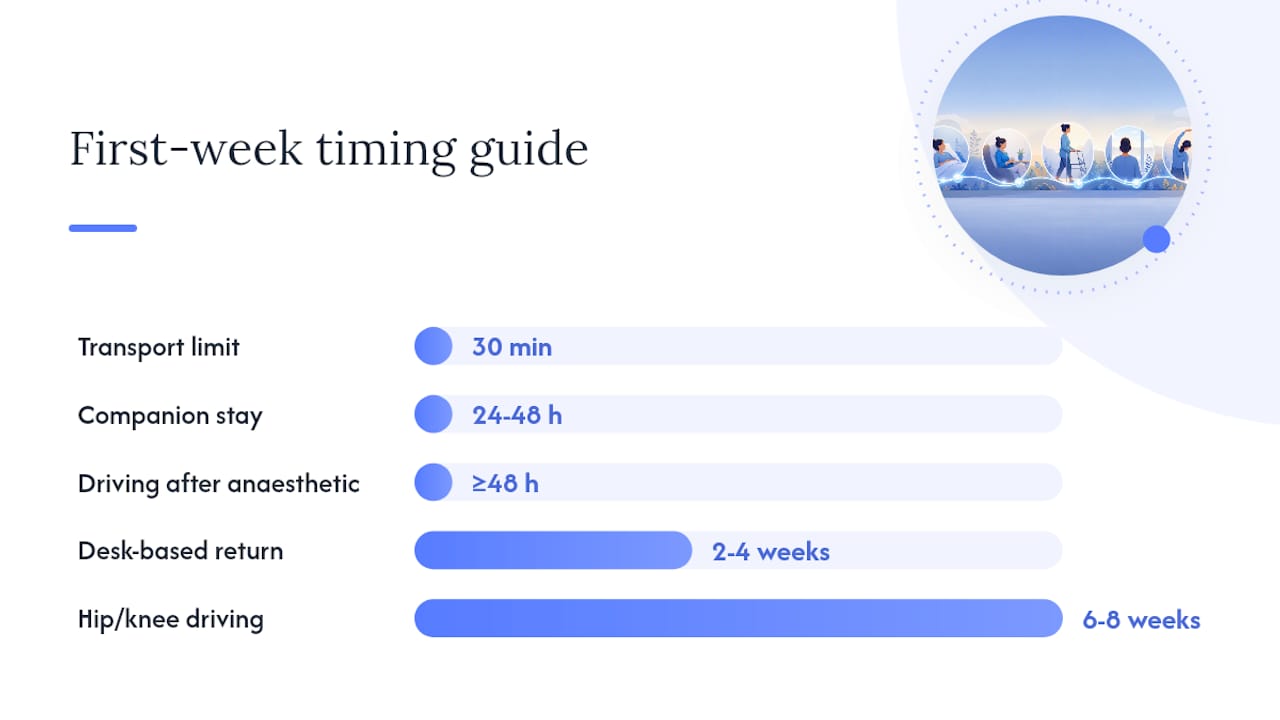
- Arrange transport home that does not require you to sit in a cramped position for more than 30 minutes (relevant especially after hip or spinal surgery).
- Ensure someone can stay with you for at least the first 24–48 hours.
- Set up a sleeping area on the ground floor if stairs are difficult.
- Prepare easy-to-eat, protein-rich food in advance.
- Have a mobility aid (crutches, walking frame) ready if prescribed.
Daily practical tips for week one
- Set an alarm for pain medication rather than waiting until pain peaks.
- Structure short walks every two to three hours; use a timer if needed.
- Keep a simple pain and activity diary to share at your follow-up.
- Eat small meals regularly even if appetite is low; protein and hydration support healing.
- Manage constipation proactively: laxatives are often prescribed alongside opioid pain relief, and adequate fluid intake helps.
Returning to work and driving
Return-to-work timing depends on job type. Desk-based roles are often possible within two to four weeks for laparoscopic procedures and one to two weeks for minor day-case surgery. Manual work, roles requiring prolonged standing, or jobs with infection risk (such as healthcare) typically require a longer absence. Discuss a phased return with your employer and GP.
For driving, the practical test is whether you can perform an emergency stop safely and without hesitation. The NHS advises avoiding driving for at least 48 hours after a general anaesthetic due to cognitive effects, but most surgical procedures carry longer restrictions. After hip or knee replacement, six to eight weeks is a common minimum. Always confirm with your surgeon before driving. For patients who had surgery abroad, practical guidance on travelling after knee surgery covers transport planning in more detail.
When will you see your final results?
The surface of a wound can look healed within two to four weeks, but that appearance is misleading. Beneath the skin, tissue remodelling continues for considerably longer.
Collagen fibres in a healing scar are initially laid down in a disorganised pattern. Over the following months, the body reorganises this collagen into stronger, more aligned structures. This process, called scar maturation, typically takes 12–18 months to complete. During this time, a scar may go through phases of being raised, red or itchy before gradually flattening and fading.
For joint replacement surgery, meaningful strength gains continue for six to twelve months post-operatively. Patients who engage consistently with physiotherapy during this window typically achieve better long-term function than those who stop once basic mobility is restored. If you had a discectomy or spinal decompression, nerve recovery can continue for up to 18 months after the procedure.
Persistent fatigue beyond six weeks, or functional progress that seems to plateau, is worth discussing with your surgical team. It may indicate a need for additional rehabilitation, a nutritional assessment, or investigation of an underlying factor such as anaemia or low mood. Psychological recovery runs in parallel with physical healing: anxiety, low mood and frustration about slower-than-expected progress are common and respond well to early acknowledgement and, where needed, professional support.
What the evidence says about faster, safer recovery
The strongest evidence for improving post-surgery recovery time sits in three areas: early mobilisation, nutritional support and multimodal pain control. These are the pillars of Enhanced Recovery After Surgery (ERAS) pathways, now used across NHS trusts and internationally.
ERAS-style pathways consistently show reductions in length of hospital stay and complication rates; patients benefit most when mobility, pain control and nutrition are addressed together rather than in isolation. Even modest early activity, such as sitting out of bed and taking short walks, significantly lowers the risk of venous thromboembolism and respiratory complications compared with prolonged bed rest.
Research-backed takeaways for patients
- Early mobilisation (same day or day one post-operatively, with clinical approval) reduces DVT risk and chest complications.
- Adequate protein intake supports collagen synthesis and wound repair; malnutrition before or after surgery is an independent predictor of poorer outcomes.
- Multimodal analgesia (combining paracetamol, anti-inflammatories and nerve-targeted agents where appropriate) reduces opioid requirements and their associated side effects, including constipation and sedation.
- Smoking cessation before surgery reduces wound infection rates and improves anaesthetic safety.
- Pre-operative exercise (prehabilitation) is associated with faster post-operative functional recovery, particularly for joint and abdominal procedures.
The limits of the evidence matter too. Generic timelines are population averages. The American College of Surgeons is explicit that recovery is highly individual and that patients should follow their own surgical team’s plan rather than any general estimate. Use published guidance for orientation; use your surgeon’s instructions for decisions.
What recovery actually feels like: a realistic picture
The physical arc of recovery is rarely linear. Most patients describe the first three days as the hardest, a noticeable improvement around day four or five, and then a period of two to three weeks where progress feels frustratingly slow. Energy levels fluctuate. A day of increased activity is often followed by a day of greater fatigue. This is normal physiology, not regression.
Emotionally, the period between two and six weeks is often the most difficult. The acute crisis of surgery has passed, but full function has not returned. Motivation can dip. Sleep is often disrupted by discomfort or medication. Feeling low, irritable or anxious during this stretch is common and does not require a clinical label to be taken seriously.
Practical reassurance points worth keeping in mind:
- Fatigue at four weeks after major surgery is not a sign of slow healing; it is a sign that your body is doing significant repair work.
- Slow progress in a single week does not predict overall outcome.
- Physiotherapy follow-up and clinic review appointments exist precisely for the moments when you are unsure whether your progress is on track.
Aftercare options vary: your surgical team may offer telephone follow-up, outpatient physiotherapy, or community nursing visits depending on your procedure and local NHS provision. If you are having surgery abroad, agree the follow-up plan with the clinic in writing before you travel, including who you contact and who pays if something goes wrong once you are home.
An editorial perspective on what patients underestimate about recovery
The most consistent gap between patient expectation and clinical reality is not about pain. Most people expect pain. What catches patients off guard is the cognitive and emotional weight of the middle weeks: the period from roughly day ten to week six when the wound looks better, visitors have stopped coming, and yet full function is still weeks away.
Clinicians often describe this as the “expectation cliff.” Patients set a mental milestone, usually the suture removal appointment, and expect to feel substantially recovered by then. When they do not, the gap between expectation and experience reads as failure rather than normal physiology.
The evidence from ERAS research points to something worth sitting with: recovery is not passive. The patients who do best are not necessarily the ones with the easiest procedures or the youngest bodies. They are the ones who treat mobilisation, nutrition and sleep as active clinical tasks rather than things that happen around them. That framing shift, from patient to participant, is the most underrated factor in any surgery rehabilitation timeline.
Generic timelines are useful for planning. They are poor predictors of individual experience. The week-by-week framework in this guide gives you a map, but your surgical team holds the territory-specific knowledge. Use both.
This article is general information, not a substitute for advice from a qualified doctor. Consult a qualified healthcare professional about your own circumstances before acting on anything here.
Sources
Use these sources for general education and orientation. Your surgeon’s discharge instructions and follow-up plan take precedence over any published guideline.
NHS and UK clinical guidance
- Having an operation (surgery) - Getting back to normal - NHS
- Recovering from surgery | ACS
- Successful recovery after major surgery: moving beyond length of stay - PMC
Professional society guidance
Peer-reviewed evidence
Procedure-specific timelines on Thera Travel
Recommended
- Hair Transplant Recovery Timeline: Day by Day (2026) | Thera Travel
- Recovery Time for Discectomy: What to Expect Week-by-Week | Thera Travel
- Knee Replacement Recovery Time And How to Heal Quicker | Thera Travel
- Hip Replacement Recovery Time And How to Heal Quicker | Thera Travel

Written by Saher Shodhan
Saher Shodhan is the founder of Thera Travel, which publishes what the official records show about clinics abroad, each fact with the date it was checked, and answers patients' enquiries, free. More about Thera → How we write and check our guides →
Related posts

Cross Border Directive: how to get the HSE to refund treatment abroad
Hip and knee replacement abroad from Ireland: costs, waits and HSE refunds