
Celebrity surgeons
How to choose one safely in the UK
Home › Guides › Celebrity surgeons: how to choose one safely in the UK

The term “celebrity surgeon” describes a practitioner who combines a high surgical caseload, documented revision expertise, concierge-level privacy services, and a public reputation built through media visibility and high-profile clientele. For a UK reader, that combination is worth unpacking carefully, because the “celebrity” label is partly marketing and partly clinical reality.
Before you read further, three things you can do right now:
- Check the surgeon’s GMC registration and confirm their licence to practise is current.
- Verify membership of BAAPS (British Association of Aesthetic Plastic Surgeons) or BAPRAS (British Association of Plastic, Reconstructive and Aesthetic Surgeons).
- Request documented revision rates and complication data in writing before any consultation.
The sections below cover how to verify credentials step by step, what to ask at consultation, realistic procedure outcomes, UK versus overseas costs, and how to apply the same checks to a clinic abroad.
Key takeaways
Verifying a celebrity surgeon’s credentials through GMC, BAAPS or BAPRAS, and CQC registration is the single most important step a UK patient can take before booking any cosmetic procedure.
| Point | Details |
|---|---|
| Verify credentials first | Check GMC registration, BAAPS/BAPRAS membership, and CQC clinic accreditation before any consultation. |
| Separate brand from clinical record | Media visibility and celebrity association are not evidence of surgical outcomes; request dated case series. |
| Ask the right consultation questions | Complication rates, revision protocols, hospital privileges, and anaesthetist credentials are non-negotiable asks. |
| Set realistic outcome expectations | Surgery results take three to six months to settle; editing and non-surgical maintenance shape celebrity images significantly. |
| Same checks abroad | Overseas, check the clinic on its country’s official register and the surgeon on their professional register before you book. |
Already have a clinic in mind? See what the official records say about it →
Ask us about treatment abroad, free
Tell us what you're looking into. We send your enquiry to relevant, pre-vetted clinics, and up to 3 that can help contact you directly.
Thera is free for patients. No clinic can pay to change the prices we publish.
Table of Contents
- What do people actually mean by “celebrity surgeon”?
- Why do celebrities pick particular surgeons?
- How do you verify a celebrity plastic surgeon’s credentials in the UK?
- What should you ask at consultation?
- What procedures do celebrities commonly choose, and what are realistic expectations?
- Recovery timelines and aftercare for high-profile patients
- How do UK costs compare with overseas, and when does medical tourism make sense?
- What actually predicts a good outcome from a high-profile surgeon?
- The case for a credentials-first approach to famous plastic surgeons
- How to check a clinic abroad before you book
- Sources
What do people actually mean by “celebrity surgeon”?
The phrase gets used loosely. At its most meaningful, it describes a surgeon who has built a reputation treating public figures, typically through a combination of technical skill, discretion, and the kind of concierge infrastructure that high-profile clients require. At its least meaningful, it is a marketing badge.
The defining features of a genuinely high-calibre practitioner in this space tend to cluster around four things:
- High surgical caseload with documented outcomes across a range of procedures, not just one signature operation.
- Revision expertise: the ability to correct previous work, which is arguably the hardest test of surgical skill.
- Privacy infrastructure: private operating facilities, non-disclosure agreements, and bespoke recovery arrangements.
- Media visibility: appearances in publications, social media presence, or association with named celebrities.
The fourth attribute is the one to treat with the most scepticism. As the career of the late Dr Ivo Pitanguy illustrates, surgeon celebrity status has long combined genuine surgical skill with deliberate marketing; public prominence is partly cultivated, not purely earned through outcomes. Pitanguy was, by most accounts, an exceptional surgeon, but his fame was also a product of carefully managed public relations.
Geographically, the principal hubs for this tier of practice are Beverly Hills and Harley Street, London, with smaller concentrations in New York, Miami, Dubai, and Istanbul. For UK patients, Harley Street is the most accessible entry point, though it carries a corresponding price premium. Internationally recognised practitioners in these hubs often charge fees that reflect their brand as much as their skill, which is why credential verification matters so much before you spend a penny.
Why do celebrities pick particular surgeons?
Privacy is usually the first filter. Surgeons who treat public figures operate under strict non-disclosure agreements, use private operating theatres separate from general hospital lists, and offer recovery suites where a patient can convalesce without encountering other patients or staff. That infrastructure is expensive to maintain, which partly explains the fee levels.
Beyond logistics, the clinical reasons celebrities gravitate towards certain surgeons are more specific than they might appear:
- Natural-looking outcomes: techniques such as SMAS (superficial musculoaponeurotic system) and deep-plane facelifts are favoured for public-facing clients precisely because they preserve recognisability rather than producing the stretched or operated appearance associated with older methods.
- Revision capability: a performer whose livelihood depends on their appearance cannot afford a poor outcome sitting unaddressed for months. Surgeons who attract this clientele tend to have robust revision protocols and fast-track access to theatre.
- Long-term partnership: high-profile practitioners increasingly position themselves as long-term partners in patient health, combining surgery with pre-procedure wellness plans and structured post-operative support rather than a single transactional procedure.
The case of Dr Thaïs Aliabadi, Hollywood’s most sought-after OB/GYN, illustrates how a celebrity clinician can become a brand in their own right, combining personalised care, high discretion, and media activity. The lesson for patients is that the brand and the clinical record are two separate things.
Hollywood’s long-running lists of trusted clinicians also show that reputation in this field is built through referrals and multidisciplinary networks, not just individual fame. A surgeon embedded in a network of dermatologists, oculoplastic surgeons, and specialist anaesthetists is a meaningfully different proposition from one operating in isolation.
Pro Tip: When a surgeon’s social media following is larger than their documented case series, treat that as a signal to dig deeper into their clinical record rather than their follower count.
How do you verify a celebrity plastic surgeon’s credentials in the UK?
This is where most patients underinvest their time. A credible verification process takes roughly an hour and can prevent a great deal of harm.
- Check GMC registration. Every doctor practising in the UK must be registered with the General Medical Council. Search the register by name and confirm the licence status shows “Registered with a licence to practise.” Also check whether any conditions, undertakings, or warnings are attached to the registration.
- Confirm specialist training. For plastic surgery, look for a Certificate of Completion of Training (CCT) in plastic surgery and the FRCS(Plast) qualification. These confirm the surgeon completed a recognised UK training pathway, not just a short aesthetic medicine course.
- Check BAAPS or BAPRAS membership. Both organisations require members to hold full GMC registration, a CCT in plastic surgery, and practice within a recognised hospital setting. Membership is not automatic and is a meaningful quality filter.
- Verify CQC registration for the clinic. The Care Quality Commission regulates independent healthcare providers in England. A clinic carrying out surgical procedures must be registered with the CQC; you can search the register online. Scotland, Wales, and Northern Ireland have equivalent bodies (Healthcare Improvement Scotland, Healthcare Inspectorate Wales, and the Regulation and Quality Improvement Authority respectively).
- Confirm hospital privileges. A surgeon with named privileges at a recognised private hospital (such as The London Clinic, King Edward VII’s Hospital, or HCA Healthcare UK) has been credentialled by that institution’s medical advisory committee. That is an independent check on their competence.
- Review before-and-after galleries critically. Look for dated images with consent statements. Undated galleries, or galleries where every image appears to have been professionally lit and retouched, tell you very little about typical outcomes.
- Check for complaints or disciplinary history. The GMC’s Fitness to Practise decisions are publicly searchable. The Independent Healthcare Providers Network (IHPN) also publishes guidance on how to raise concerns.
Pro Tip: Take screenshots of the GMC register entry, BAAPS/BAPRAS membership page, and CQC registration on the day you check them. Date-stamp the screenshots. If anything changes between your research and your procedure, you have a contemporaneous record.
What should you ask at consultation?
A consultation with a surgeon at this level should feel like a rigorous clinical conversation, not a sales meeting. If it feels like the latter, that is itself a red flag.
A short consultation script
Use these prompts to structure the conversation:
- What is your GMC registration number, and may I see your CCT certificate?
- How many procedures of this exact type have you performed in the past 12 months?
- What is your documented complication rate for this procedure, and how do you manage complications?
- What is your revision rate, and what does your revision process look like?
- Which hospital or facility will the procedure take place in, and what are your privileges there?
- Who is your anaesthetist, and are they a consultant with their own GMC registration?
- What does the aftercare package include, and who is my point of contact post-operatively?
- What is the realistic recovery timeline before I can return to work and normal activity?
- Can I see a dated case series for patients with similar anatomy to mine?
- Are the before-and-after images on your website consented and undated, or do they carry dates and consent statements?
- What happens if I am unhappy with the result?
- Is there a cooling-off period before I need to confirm my decision?
Red flags to watch for
- Evasive or vague answers about revision rates or complication management.
- Pressure to book or pay a deposit at the first consultation.
- Cash-only payment requests or resistance to providing a written treatment plan.
- Before-and-after images without dates or consent statements.
- No named anaesthetist or no clear hospital affiliation.
- Dismissiveness when you ask about second opinions.
Request a dated case series and ask whether any patients with similar starting anatomy would be willing to provide a reference. Reputable surgeons at this level will have this material available.
What procedures do celebrities commonly choose, and what are realistic expectations?
Surgeon practice pages at this level typically list a consistent set of specialisms: deep-plane facelifts, endoscopic brow lifts, blepharoplasty (eyelid surgery), rhinoplasty, and fat transfer. Body procedures, including liposuction, abdominoplasty (tummy tuck), and breast surgery, feature alongside hair restoration and advanced non-surgical aesthetics such as injectables, skin resurfacing, and thread lifts.
The procedures most commonly associated with celebrity cosmetic surgery include:
- Rhinoplasty (nose reshaping), often performed in multiple stages.
- SMAS and deep-plane facelifts for natural facial rejuvenation.
- Blepharoplasty, both upper and lower lid.
- Fat transfer to the face, hands, or body.
- Body contouring: liposuction, abdominoplasty, and arm lifts.
- Breast augmentation, reduction, or revision.
- Hair restoration (FUE transplants and PRP protocols).
- Non-surgical: botulinum toxin, dermal fillers, laser resurfacing, and skin-tightening treatments.
Celebrities frequently combine surgical and non-surgical approaches, maintaining results with regular non-surgical maintenance between procedures. What patients often underestimate is the role that professional lighting, make-up, and post-production editing play in the images they see.
Surgery can refine structure, restore volume, and address specific concerns with precision. It cannot replicate a professional photography setup, a team of retouchers, or years of non-surgical maintenance. Visible results from most surgical procedures take three to six months to fully settle, and final rhinoplasty results can take up to a year.
Recovery timelines and aftercare for high-profile patients
High-profile patients typically require more logistical planning around recovery than the average patient, not because their biology is different, but because their professional obligations and privacy requirements are more demanding.

| Procedure | 48 hours | 1–2 weeks | 4–6 weeks | 3–6 months |
|---|---|---|---|---|
| Facelift (SMAS/deep plane) | Rest, head elevation, drain monitoring | Suture removal, bruising fading | Light social activity | Final result visible |
| Rhinoplasty | Splint in place, significant swelling | Splint removed, presentable indoors | Return to most activities | Tip refinement continues |
| Blepharoplasty | Cold compresses, limited screen time | Sutures out, bruising mostly resolved | Full activity resumed | Scars mature |
| Abdominoplasty | Compression garment, limited mobility | Light walking, no driving | Return to desk work | Full activity, final contour |
| Breast surgery | Rest, arm movement restricted | Supportive bra, light activity | Return to most exercise | Final shape settles |
Aftercare options used by high-profile patients include:
- Dedicated private recovery suites within the clinic or an affiliated facility.
- In-home nursing arranged through the surgeon’s concierge team.
- Discreet hotel arrangements with medical-grade aftercare on call.
- Staged follow-up appointments scheduled to avoid clinic waiting areas.
For UK patients, practical considerations include a minimum rest period of 48 hours before any travel following general anaesthetic, and most surgeons recommend avoiding flights for at least two weeks after major procedures. Aftercare quality is a primary determinant of outcome, particularly for procedures with extended healing timelines.
How do UK costs compare with overseas, and when does medical tourism make sense?
UK prices for procedures at Harley Street or equivalent private London clinics sit at the higher end of the global range. The cost drivers are surgeon fees, private hospital facility fees, anaesthetist fees, and post-operative care. A deep-plane facelift in London can cost between £15,000 and £30,000 depending on the surgeon’s profile and the facility. Rhinoplasty typically ranges from £6,000 to £15,000. These figures are indicative; actual quotes vary significantly.
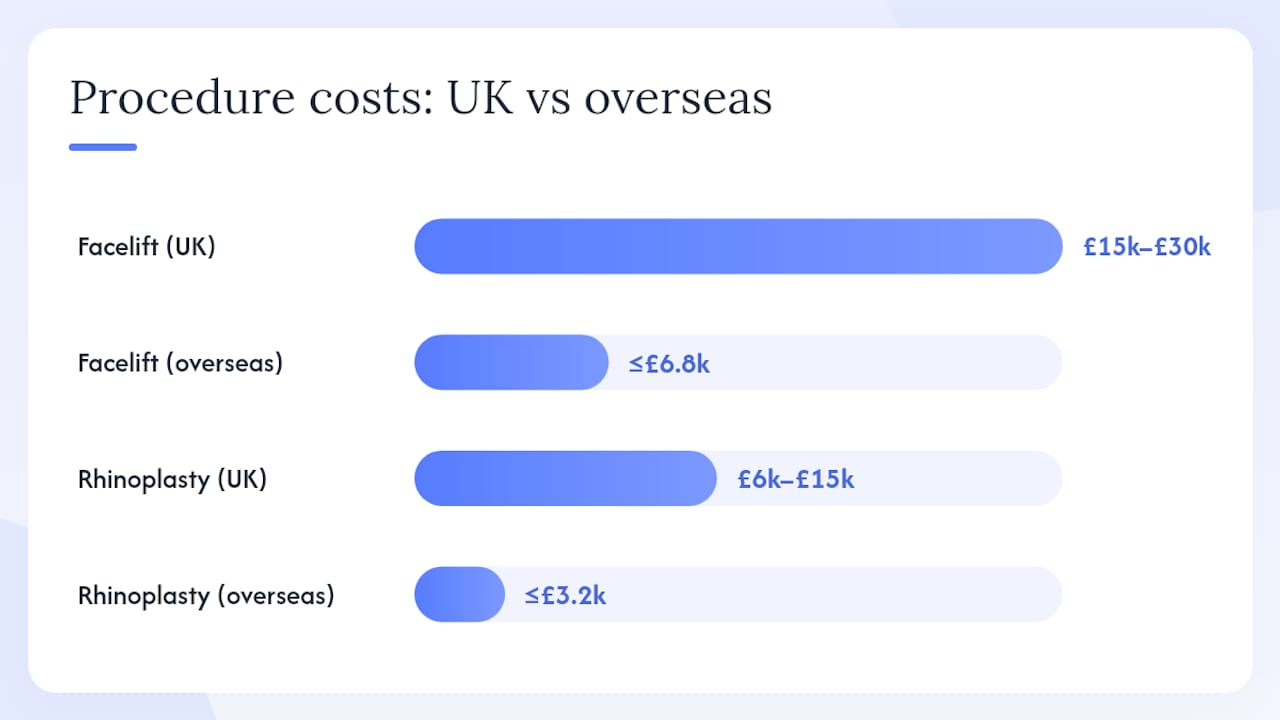
Overseas clinics in countries such as Turkey, Poland, and the Czech Republic can offer substantially lower prices for comparable procedures, with savings of up to 70% against UK private rates cited by medical travel platforms. The Turkey versus UK cost comparison is one of the most searched routes for UK patients considering cosmetic surgery abroad.
Pros and cons of UK care versus international clinics:
- UK care: continuity of care with your GP, CQC-regulated facilities, straightforward access to NHS emergency services if complications arise, and no travel logistics. The trade-off is cost and, for some procedures, waiting time at reputable clinics.
- International clinics: significantly lower costs, often shorter waiting times, and access to surgeons with high-volume caseloads in specific procedures. The trade-offs are distance from home during recovery, variable regulatory frameworks, and the need for rigorous independent vetting.
Pro Tip: When evaluating an overseas clinic, check whether the surgeon is registered with their country’s equivalent of the GMC, whether the facility holds international accreditation (such as JCI), and whether the clinic has a documented protocol for transferring patients to a local hospital in the event of a serious complication. Ask for this in writing before you book. Our guide to vetting a cosmetic surgeon abroad covers this process step by step.
What actually predicts a good outcome from a high-profile surgeon?
The answer is less glamorous than the marketing suggests. Industry analysis consistently frames surgeon skill and judgement as the primary predictor of success, rather than any single branded technique or celebrity association. The specific attributes that correlate with reliable outcomes are:
- Depth of surgical experience in the exact procedure you are considering, measured in documented cases rather than years in practice.
- Revision track record: a surgeon who handles revisions regularly, and can show you that case history, has demonstrated the full range of their skill.
- Multidisciplinary team: surgeons who treat high-profile clients tend to work within networks that include specialist anaesthetists, dermatologists, and oculoplastic surgeons. Referral networks and multidisciplinary hospital privileges are a meaningful trust signal.
- Honest before-and-after evidence: dated, consented, unedited follow-up images. Marketing and social media can inflate perceived outcomes, and requesting dated, unedited follow-up images is one of the most effective checks available to a prospective patient.
A surgeon’s public profile is a useful starting point for initial screening, but it must be validated by official registers, documented outcomes, and evidence of multidisciplinary hospital privileges before it carries any real weight.
Pro Tip: Ask to see examples of patients with similar starting anatomy to yours, with documented follow-up photographs that carry dates and consent statements. A surgeon confident in their outcomes will have this material ready.
The case for a credentials-first approach to famous plastic surgeons
The celebrity surgeon category rewards scepticism. A practitioner’s media presence, their association with famous names, and the polish of their clinic’s website are all separable from the question of whether they are the right surgeon for your procedure.
What I find most telling, having reviewed how this field operates, is that the surgeons with the strongest clinical reputations tend to be the least reliant on celebrity association as a selling point. Their case series speak clearly enough. The ones who lead with famous patient names and glossy social media content are often compensating for a thinner clinical record.
The verification steps in this article are not bureaucratic box-ticking. They are the minimum due diligence for a decision that carries real physical risk. GMC registration, BAAPS or BAPRAS membership, CQC-accredited facilities, documented revision rates, and honest before-and-after evidence: these are the signals that matter. Everything else is atmosphere.
How to check a clinic abroad before you book
The same credentials-first approach works if you are looking at a clinic outside the UK. It is harder only because the registers are foreign and often not in English.
- Find the clinic on its country’s official register, under the legal name on the quote.
- Get the surgeon’s name in writing and look them up on their country’s professional register.
- Read the reviews, including the low-rated ones, and check which Google listing is the actual hospital.
- Get the quote itemised in writing, showing what is included and what is not.
- Ask what happens if something goes wrong once you are home, and who pays.
Our 15 questions to ask a clinic sets these out in full. Thera Travel does not recommend clinics or surgeons. If you have one in mind, see what the records say about it, free.
Sources
These are the registers and bodies to consult when researching any surgeon or clinic in the UK:
- Top Cosmetic Doctors and Aesthetic Gurus in America
- Hollywood’s top doctors
- Ivo Pitanguy, Plastic Surgeon to the Stars and a Celebrity Himself, Dies at 93 - The New York Times
This article is general information, not a substitute for advice from a qualified doctor. Consult a qualified healthcare professional about your own circumstances before acting on anything here.
Recommended
- Is Plastic Surgery Abroad Safe? (2026 Honest Guide) | Thera Travel
- How to Vet a Cosmetic Surgeon Abroad (2026) | Thera Travel
- How to Choose a Hair Transplant Clinic Abroad (2026) | Thera Travel
- Is a BBL Abroad Safe? (2026 Honest Guide) | Thera Travel
Written by Saher Shodhan
Saher Shodhan is the founder of Thera Travel, which publishes what the official records show about clinics abroad, each fact with the date it was checked, and answers patients' enquiries, free. More about Thera → How we write and check our guides →
Related posts
Cross Border Directive: how to get the HSE to refund treatment abroad
Hip and knee replacement abroad from Ireland: costs, waits and HSE refunds