

What is medical itinerary planning? A UK patient guide
Home › Guides › What is medical itinerary planning? A UK patient guide

A medical itinerary plan is a single, clinician-centred schedule that organises your consultations, tests, travel, accommodation, and recovery into one coherent document so that every provider involved, from your UK GP to the surgical team abroad, is working from the same plan. The golden rule: build the itinerary around the lead clinical appointment, not the cheapest flight.

Before you do anything else: send your recent medical records to the clinic and request an initial clinical review. That review tells you realistic dates, which tests are needed, and how long you genuinely need to stay. Only then should you touch a flight booking tool.
Three things to hold in mind from the outset:
- Clinical sequencing comes before flights. The appointment that unlocks the rest of the plan must be confirmed first.
- Build in flexibility for fit-to-fly clearance. Surgeons can and do withhold certificates if recovery milestones are not met.
- Your UK GP is part of the plan, not an afterthought. Continuity of care starts before you leave.
Table of Contents
- What does a medical travel itinerary actually contain?
- Why deliberate planning matters more than most patients expect
- How do you build a medical itinerary step by step?
- A sample 5-day itinerary and reusable checklist
- What does medical travel typically cost, and how long does it take?
- What mistakes do patients make, and what are the red flags?
- What documents do you need, and what questions should you ask?
- Key takeaways
- Why the itinerary is only as good as the clinic behind it
- How to check a clinic before you book
- Useful sources and further reading
Ask us about treatment abroad, free
Tell us what you're looking into. We send your enquiry to relevant, pre-vetted clinics, and up to 3 that can help contact you directly.
Thera is free for patients. No clinic can pay to change the prices we publish.
What does a medical travel itinerary actually contain?
A complete itinerary for medical travel covers six areas. Miss any one of them and you create a gap that tends to surface at the worst possible moment, usually mid-trip.
Appointment schedule
- Lead consultation (the appointment that determines everything else)
- Pre-operative tests and results review
- Procedure or treatment day
- Post-operative checks and wound reviews
- Discharge assessment
Travel logistics
- Arrival window (at least one day before the first appointment)
- Airport transfer arrangements, including wheelchair or mobility needs
- Flexible or changeable return ticket
- Domestic transfers between accommodation and hospital
Accommodation
- Location relative to the hospital (ideally within 15 minutes)
- Recovery suitability: lift access, ground floor, proximity to pharmacy
- Companion arrangements and costs
Recovery and aftercare
- Observation days required before discharge
- Physiotherapy or dressing appointments
- Medication supply to cover the return journey and the first weeks at home
- Fit-to-fly criteria confirmed in writing
Contacts and documents
A written itinerary should capture these fields at minimum:
| Field | What to record |
|---|---|
| Hospital name and address | Full address plus emergency number |
| Lead clinician | Name, direct contact, and specialty |
| International patient coordinator | Name, mobile, and email |
| UK GP | Name, surgery number, and out-of-hours contact |
| Appointment times | Date, time, location within hospital |
| Transport | Pickup time, driver contact, vehicle type |
| Fasting or medication notes | Specific pre-procedure instructions |
| Insurance policy number | Insurer name and claims line |
Already have a clinic in mind? See what the official records say about it →
Why deliberate planning matters more than most patients expect
Poor sequencing is the most common and most costly mistake in medical travel planning. If you book flights before the clinic has reviewed your records, you risk arriving for a procedure that cannot go ahead because a prerequisite test was never done, or because the surgeon needs a result that takes longer than you allowed.

When multiple specialties are involved, the sequencing problem compounds. One specialist’s findings may change another’s plan entirely. Getting that sequence wrong means repeat visits, duplicate tests, and in some cases a procedure that turns out to be inappropriate once the full picture emerges.
There is a financial dimension too. Non-refundable flights booked before clinical dates are confirmed, accommodation that does not suit post-operative mobility needs, and an extended stay you did not budget for are all predictable consequences of logistics-first planning. A well-structured health trip itinerary prevents most of them.
Good planning also protects continuity of care. Your UK GP needs to know what was done, what medications were prescribed, and what follow-up is required. That loop only closes if the itinerary includes a clear handover plan from the outset.
How do you build a medical itinerary step by step?
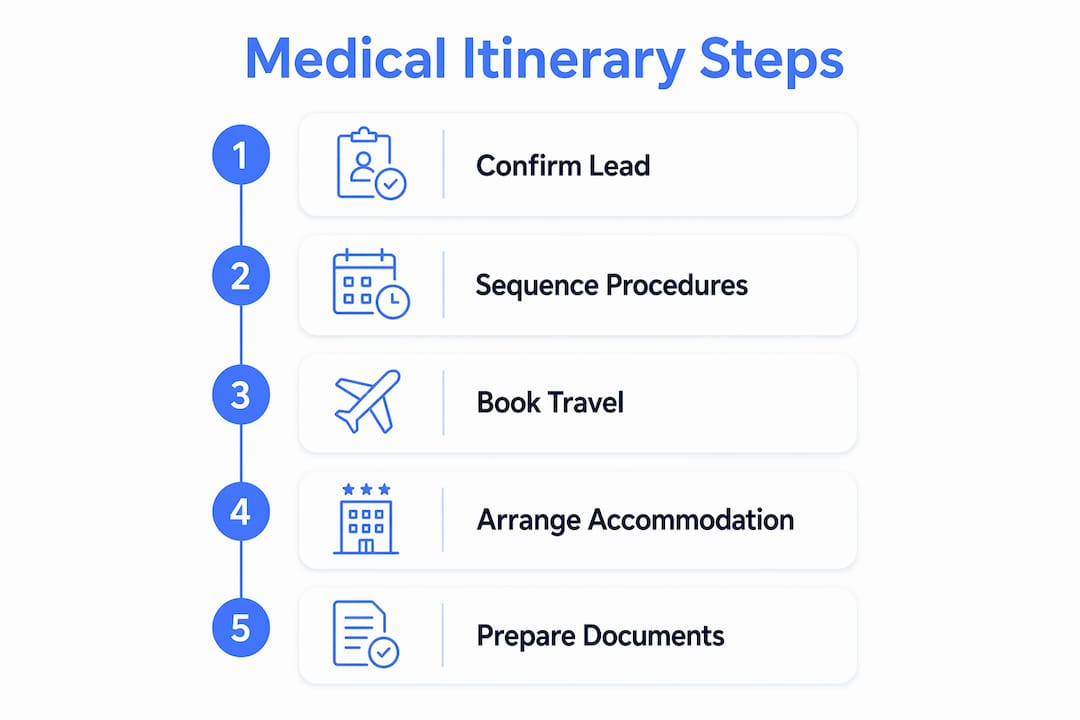
Follow this sequence and the itinerary builds itself around clinical reality rather than wishful thinking.
-
Send recent records and state your primary goal. Before any dates are discussed, send your records first and specify whether you are seeking a second opinion, a diagnostic workup, or a specific procedure. The clinic cannot give you a realistic timeline without them.
-
Request an estimated care timeline. Ask the clinic to identify the lead consultation or diagnostic that unlocks the rest of the plan. This is the appointment everything else hinges on.
-
Choose flexible travel windows. Offer two or three possible arrival windows rather than a fixed date. Book changeable return tickets. Surgeons may decline fit-to-fly certificates if recovery milestones are not met, so a fixed return date is a liability.
-
Schedule arrival at least one day before the first appointment. Buffer days for tests and results are not optional extras; they are part of the clinical sequence.
-
Clear pre-travel checks with a travel medicine clinician and your GP 4–6 weeks before departure. The CDC recommends this window to assess fitness to travel, review vaccinations, and plan any medication changes needed for the trip.
-
Confirm fit-to-fly criteria in writing and plan a contingency for extended stay. Know exactly what milestone triggers clearance to fly, and budget for extra nights if that milestone takes longer than expected.
Timeline examples by trip type:
| Trip type | Typical duration | Key sequencing note |
|---|---|---|
| Diagnostic visit | 3–5 days | Arrival, tests, results review, debrief |
| Procedure with short recovery | 7–10 days | Pre-op day, procedure, observation, discharge check |
| Complex or multispecialty care | 14+ days | Lead consultation first; subsequent specialties follow |
Pro Tip: Always set the treatment sequence before you set any travel dates. Many clinics will not lock in procedure dates until fit-to-fly criteria and any multidisciplinary reviews are complete. Trying to force dates before that stage wastes everyone’s time and can compromise your safety.
A sample 5-day itinerary and reusable checklist
This example covers a short surgical procedure with one pre-operative day and one post-operative check. Adapt the structure to your own trip length.
Day-by-day sample:
- Day 1 — Arrival. Transfer from airport to accommodation. Rest. Confirm appointment time and fasting instructions with coordinator.
- Day 2 — Assessment. Lead consultation with surgeon. Pre-operative blood tests and imaging. Confirm procedure time and any medication changes.
- Day 3 — Procedure day. Arrive fasting as instructed. Procedure. Recovery observation in hospital.
- Day 4 — Early recovery. Wound check or physiotherapy. Medication dispensed. Coordinator confirms fit-to-fly criteria.
- Day 5 — Final check and discharge. Discharge summary issued. Imaging and pathology collected. Transfer to airport.
Template fields to copy into your planner
- Hospital name, ward, and room number
- Lead clinician name and direct contact
- Appointment date, time, and building location
- Transport: pickup time and driver contact
- Fasting instructions and medication timing
- Emergency contact at the hospital
- International patient coordinator mobile
- Insurance policy number and claims line
- UK GP name and surgery number
Printable pre-departure checklist
- [ ] Medical records sent to clinic and acknowledged
- [ ] Written itinerary received from coordinator
- [ ] Flexible return ticket booked
- [ ] Travel medicine clearance obtained
- [ ] Specialist insurance confirmed (see insurance note below)
- [ ] Medication supply covers trip plus two weeks at home
- [ ] Digital copies of imaging stored in cloud and labelled by date and type
- [ ] GP briefed and follow-up appointment booked for return
Pro Tip: Label every digital file with your surname, date, and scan type (e.g. “Smith_MRI_Knee_March2026”). Clinicians abroad process dozens of patients; a clearly labelled file gets reviewed faster.
What does medical travel typically cost, and how long does it take?
Cost and timeline vary enormously by procedure and destination, but the budget categories are consistent across almost every trip.
Budget categories to plan for:
- Procedure fee and surgeon’s fee
- Hospital or clinic facility fee
- Anaesthesia and theatre costs
- Pre-operative tests and imaging
- Accommodation (recovery-suitable, near hospital)
- Flights (flexible or changeable fare)
- Local transfers
- Specialist complications insurance
- Companion travel and accommodation costs
- Contingency fund for extended stay
Standard travel insurance almost always excludes complications from elective procedures. Specialist complications cover should be purchased separately and may need to cover up to 180 days post-procedure. UK patients travelling to Germany, for example, may also want to review health insurance options specific to that market before departure.
Indicative budget ranges by trip type
| Trip type | Typical stay | Budget range (indicative) |
|---|---|---|
| Day case or diagnostic | 3–5 days | Lower end; procedure plus short stay |
| Short procedure with recovery | 7–10 days | Mid-range; includes observation nights |
| Complex or multispecialty | 14+ days | Higher end; factor in extended contingency |
Procedures abroad are often priced well below UK private prices (see how to compare international surgery costs), but the difference narrows quickly if you have not budgeted for flexible flights, companion costs, and specialist insurance. For a fuller breakdown of what is typically bundled in a package, the types of medical travel packages guide covers the main structures.
What mistakes do patients make, and what are the red flags?
The most damaging mistakes in medical travel planning are predictable and avoidable.
Common planning mistakes
- Booking flights around the cheapest dates rather than clinical availability
- Sending incomplete records, which forces the clinic to request them again and delays the timeline
- Underestimating recovery time and booking a return flight too early
- Failing to brief the UK GP before departure
Red flags from clinics or coordinators
- Refusal to share the lead surgeon’s credentials or registration number
- Vague or verbal-only cost estimates with no written breakdown
- No named international patient coordinator with a direct contact number
- Absence of a post-operative contact plan or follow-up protocol
- Review profiles that cannot be independently verified
Before paying any deposit, confirm
- [ ] Surgeon’s name and registration on the relevant national medical register
- [ ] Written cost breakdown covering procedure, hospital, anaesthesia, and tests
- [ ] Named coordinator with mobile number and email
- [ ] Written post-op contact plan and who covers complications
- [ ] Cancellation and change policy in writing
Pro Tip: Check the surgeon’s credentials yourself. Most countries publish searchable medical registers online. A clinic that discourages this check is telling you something important.
For a structured approach to vetting providers, the medical tourism provider guide covers the verification steps in detail.
What documents do you need, and what questions should you ask?
Gathering the right documents before any appointment saves time and prevents the most common cause of delayed treatment: an incomplete clinical picture.
Document checklist:
- Recent imaging: CT, MRI, X-rays in digital format (DICOM preferred)
- Laboratory results from the past 6–12 months
- Pathology or biopsy reports where relevant
- Current medication list with generic drug names and dosages
- Allergy list
- GP summary letter
- Passport and any required visas
- Vaccination record
- Insurance documents including policy number and claims line
Transfer records via encrypted email or the clinic’s secure patient portal. Ask the coordinator which file formats they accept before sending.
Must-ask clinical questions
- Who is the lead specialist, and what is their registration number?
- What tests will be needed before the procedure can be confirmed?
- What is the estimated length of stay, including observation days?
- What are the specific fit-to-fly criteria, and who issues the certificate?
- Who manages complications, and what is the protocol if I need to stay longer?
- How will discharge documentation be sent to my UK GP?
Logistics questions to ask the coordinator
- Who arranges airport transfers, and what are the mobility options?
- Is interpreter support available, and at what cost?
- Which accommodation options are within 15 minutes of the hospital?
- What is the cancellation and rescheduling policy?
Understanding why GPs sometimes refer patients abroad can also help frame these conversations. The why doctors refer patients abroad guide explains the clinical and logistical reasons behind those decisions.
Key takeaways
Medical itinerary planning works when clinical sequencing drives every other decision, from travel windows to accommodation choices to insurance cover.
| Point | Details |
|---|---|
| Clinical sequencing first | Confirm the lead consultation before booking any travel; it unlocks the rest of the plan. |
| Flexible return tickets | Surgeons may withhold fit-to-fly certificates until recovery milestones are met; a fixed return date is a risk. |
| Pre-travel clearance | See a travel medicine clinician and your GP 4–6 weeks before departure to confirm fitness to travel. |
| Specialist insurance | Standard travel insurance excludes elective procedure complications; purchase separate complications cover. |
| Clinic checks | Check the clinic on its official register, the surgeon on theirs, and get an itemised written quote before committing. |
Why the itinerary is only as good as the clinic behind it
Most guides on healthcare itinerary organisation focus on logistics, and logistics matter. But the itinerary is only as reliable as the clinical information feeding it. If the clinic gives you vague timelines, refuses to name the surgeon, or cannot tell you the fit-to-fly criteria in writing, no amount of careful scheduling fixes that.
What patients often underestimate is how much the quality of the international patient coordinator affects the whole experience. A good coordinator does not just send appointment times; they flag when a test result might delay the procedure, they know the hospital’s discharge process, and they have a direct line to the surgical team. A poor one copies and pastes a generic schedule and goes quiet when complications arise.
The other thing worth saying plainly: the itinerary should be a living document, not a PDF you file and forget. Dates shift, results come back differently than expected, and recovery takes longer than the optimistic estimate. Build in review points, keep the coordinator’s number accessible, and make sure your UK GP has a copy before you leave. The patients who navigate medical travel well are not the ones with the most detailed spreadsheet; they are the ones who stayed in communication with every party throughout.
How to check a clinic before you book
A careful itinerary is only worth building around a clinic that has been checked. Before you book flights, make these checks.
- Find the clinic on its country's official register of healthcare providers, under the legal name on the quote.
- Get the surgeon's name in writing and check them on their professional register.
- Read the reviews, including the low-rated ones, and check that the Google listing is the actual hospital.
- Get the quote itemised in writing, showing what is included and what is not.
- Ask what happens if something goes wrong once you are home, and who you contact.
This applies whether you are considering endoscopic spine surgery abroad, a dental procedure or a diagnostic workup. Our 15 questions to ask a clinic help with the wording. Thera Travel never recommends a clinic. You can see what the official records say about any clinic, free.
Useful sources and further reading
- Travel health guidance: CDC Medical Tourism page covers pre-travel clearance, vaccination planning, and continuity of care recommendations for patients travelling abroad for treatment.
- Patient preparation checklist: Greater National Advocates provides a practical checklist covering records, logistics, and follow-up care planning.
- Clinic accreditation: Check whether your chosen hospital holds accreditation from a recognised body such as JCI (Joint Commission International) or an equivalent national standard. Accreditation status is usually searchable on the accrediting body’s website.
- Clinician registration: Verify your lead surgeon’s registration on the relevant national medical register. Most countries publish free, searchable databases. Ask the coordinator for the surgeon’s registration number before you proceed.
- Digital records: Store imaging and pathology in a labelled cloud folder (Google Drive, Dropbox, or a dedicated medical records app) with files named by date and scan type. Carry a USB backup for hospital intake.
- Insurance: Review policy exclusions carefully. Specialist complications cover is distinct from standard travel insurance and should be in place before departure.
This article provides general information about medical travel planning and is not a substitute for professional medical or legal advice. Confirm current guidance with your GP, a travel medicine clinician, and the relevant authorities for your specific situation.
Recommended
- What Is Medical Tourism? A 2026 Patient Guide
- Dental Tourism: The 2026 UK Patient Guide | Thera Travel
- Overseas Treatment Options: Your 2026 Patient Guide
- How Patients Access Surgery Abroad: 2026 Guide

Written by Saher Shodhan
Saher Shodhan is the founder of Thera Travel, which publishes what the official records show about clinics abroad, each fact with the date it was checked, and answers patients' enquiries, free. More about Thera → How we write and check our guides →
Related posts

Cross Border Directive: how to get the HSE to refund treatment abroad
Hip and knee replacement abroad from Ireland: costs, waits and HSE refunds