
What Is Medical Tourism? A 2026 Patient Guide
Home › Guides › What Is Medical Tourism? A 2026 Patient Guide

Medical tourism means travelling to another country for medical treatment, usually planned surgery or dental work. For UK patients the draw is usually price or waiting time. On clinics' own price lists, a knee replacement costs £5,425 to £7,317 in Poland (3 price lists, checked 6 Oct 2026), against Nuffield Health's UK average guide price of £16,914 (checked 30 Oct 2026) [1] [2].
Written by Saher Shodhan. Prices abroad are from clinics' own price lists, checked 6 Oct 2026; UK prices are from providers' own price pages, checked on the date given. NHS waiting figures are from NHS England's statistics. Sources are numbered at the end.
Some hospitals abroad hold Joint Commission International (JCI) accreditation. Accreditation is a useful first filter, but it describes the hospital, not the individual surgeon. Industry websites such as the Medical Tourism Council describe the same thing from the selling side; this guide sets out what it costs, the risks and how to check a clinic yourself.
What is medical tourism, and how does it work?
Medical tourism is the practice of leaving your home country to receive treatment abroad. The industry term is "international patient services", though "medical tourism" is the phrase most patients use when searching. Both describe the same thing: arranging travel, a place to stay and medical care in another country.
Medical tourism differs from wellness tourism in one important way. Wellness travel covers spas, retreats and preventive health programmes. Medical tourism covers clinical procedures that need a diagnosis, checks before the operation, a surgeon and follow-up afterwards. Mixing the two up leads people to underestimate the planning involved.
A medical tourism package can include consultations, the hospital stay, airport transfers, an interpreter and a hotel while you recover. What is in the price differs from clinic to clinic. Ask for the package in writing, so you know which steps are covered and which you need to arrange yourself.

Ask us about treatment abroad, free
Tell us what you're looking into. We send your enquiry to relevant, pre-vetted clinics, and up to 3 that can help contact you directly.
Thera is free for patients. No clinic can pay to change the prices we publish.
Why do patients choose medical tourism?
Most decisions come down to cost, access and the treatment on offer. Industry sites say patients travel to overcome healthcare gaps such as long waits and high prices at home.
For UK patients, waiting time is part of it. In August 2026, the latest published figure, 843,419 people were waiting for trauma and orthopaedic treatment in England, and 61.1% had waited under 18 weeks [3]. NHS England publishes the September 2026 figures on 12 Nov 2026.
Price is the other part. On published prices, the gap with UK private care is large for many treatments:
- A hip replacement costs £5,425 to £5,891 on 3 Polish hospitals' price lists (checked 6 Oct 2026), against Nuffield Health's UK average guide price of £16,579 (checked 30 Oct 2026) [1] [2].
- One dental implant costs £311 to £439 on 34 Turkish clinics' price lists (checked 6 Oct 2026), against £1,050 to £1,500 for the implant alone at UK practices (re-read 31 Oct 2026) [1] [4].
- Breast augmentation costs £2,573 to £3,573 on Turkish clinics' price lists, against £6,000 to £9,300 at UK providers (checked 6 Oct 2026) [1] [4].
- Clinics abroad also publish prices for IVF, eye surgery and weight-loss surgery; the clinic price index shows them by country.
Flights, hotel nights and any return trips come on top, and so does any repair at home if something goes wrong. The NHS says that if saving money is your main reason, "make sure you've factored in fluctuating exchange rates", a possibly longer stay and "the cost of possible return trips" [5].
What medical tourism costs against UK private prices
These are the prices clinics and UK providers publish themselves. Thera Travel holds 505 clinics and hospitals in 24 countries, and 315 of them publish at least one price on their own website (checked 6 Oct 2026) [1] [6].
| Treatment | Abroad, clinics' own price lists | UK private |
|---|---|---|
| Knee replacement | Poland £5,425 to £7,317 (3 price lists) | £16,914, Nuffield Health's UK average guide price |
| Hip replacement | Poland £5,425 to £5,891 (3 price lists) | £16,579, Nuffield Health's UK average guide price |
| One dental implant | Turkey £311 to £439 (34 price lists); Hungary £399 to £586 (13 price lists) | £1,050 to £1,500 for the implant alone (5 practices) |
| Breast augmentation | Turkey £2,573 to £3,573 (7 price lists) | £6,000 to £9,300 |
Abroad: clinics' own price lists, checked 6 Oct 2026, converted at the European Central Bank rate of that day [1]. With 6 or more price lists the range is the middle half of the clinics' entry prices; with fewer, it runs from the lowest to the highest. UK: Nuffield Health's own pages, checked 30 Oct 2026 [2]; dental practices' and cosmetic providers' own pages, checked 6 to 7 Oct 2026 and re-read 31 Oct 2026 [4]. What each price includes differs.
Comparing options for your own treatment? Ask us, free →
What types of treatments do medical tourists seek?
A review in a medical journal lists cosmetic surgery, dental work, fertility treatment, organ transplantation, orthopaedic operations and heart treatment among the treatments people travel for. The range is wider than most people expect.
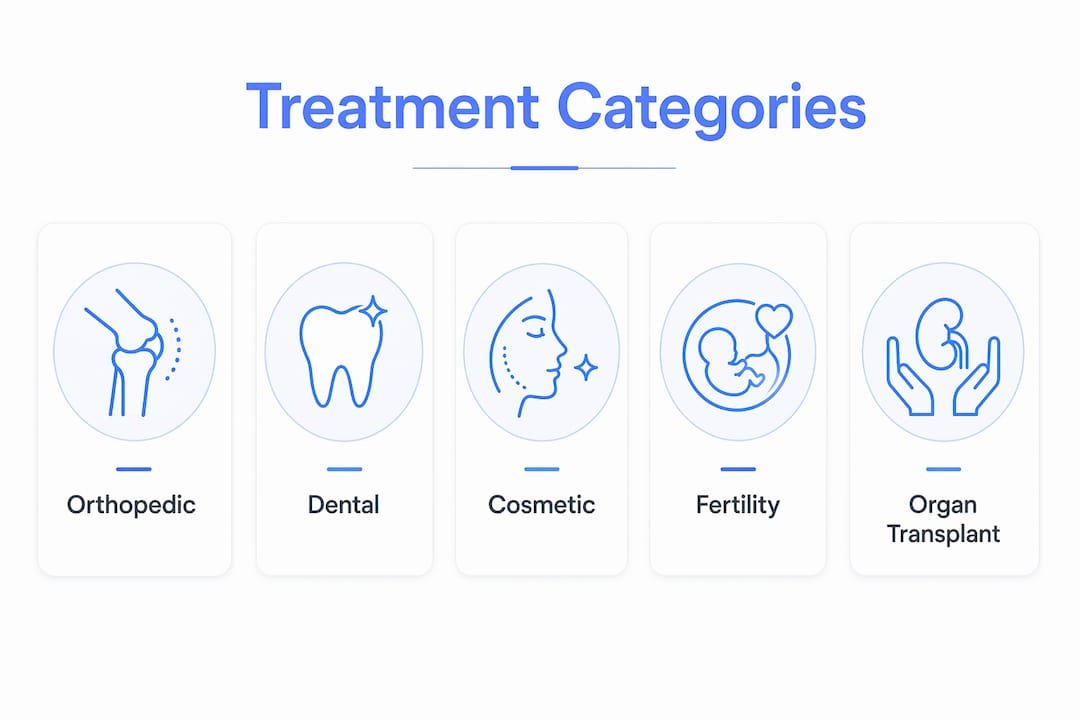
Here is a breakdown of the main treatment groups:
| Treatment Category | Common Procedures |
|---|---|
| Orthopaedic | Hip replacement, knee replacement, spinal surgery |
| Cardiovascular | Bypass surgery, valve replacement, angioplasty |
| Dental | Implants, veneers, full-mouth restoration |
| Fertility | IVF, egg donation, embryo transfer |
| Cosmetic | Rhinoplasty, liposuction, breast augmentation |
| Oncology | Targeted therapy, proton beam treatment |
Planned operations make up much of it, but some people travel for heart or cancer treatment too. Those are not lifestyle choices, and they need the most careful planning with your own doctors.
Wellness and preventive care fall outside this. A detox retreat is not medical tourism in this sense. The difference matters because treatment abroad needs checks before you go, a plan for risks, and follow-up afterwards.
Tip: Ask any clinic abroad for a full written treatment plan before you book flights. If it will not give you one, treat that as a warning sign.
Our guide to choosing a medical tourism provider shows what a well-set-out offer should include before you compare providers.
How can patients ensure safety and quality in medical tourism?
The NHS says: "All types of medical treatment involve some element of risk" [5]. What you can control is the checking. Some providers write about the vetting of hospitals and surgeons; the point is that a country's reputation tells you little about one clinic.
Follow these steps for any clinic abroad:
- Look up the clinic. Find it on its country's official register under the legal name on your quote. If it says it holds JCI accreditation, look it up in JCI's own directory.
- Look up the surgeon. Get their full name in writing and check it on their country's register of doctors or dentists, where one is public. Ask how many of your procedure they do each year.
- Decide whether to use a medical travel facilitator. Facilitators can arrange tests, travel and contact with your doctors at home. Many are paid by the clinics they send patients to, so check the clinic and surgeon yourself either way. If you arrange things directly, plan the aftercare with particular care.
- Plan your aftercare before you travel. The NHS says: "Ensure you're clear about how your aftercare will be coordinated" [5]. Get written instructions for after the operation, in English, before you leave the hospital abroad.
- Read the contract carefully. Know what happens if something goes wrong, who pays for a second operation, and how complaints are handled.
Accreditation can be checked in the accreditor's own directory, so you do not have to take a clinic's word for it. How we check a clinic explains which records we use.
Tip: Ask any facilitator for the name of the surgeon who will operate before you pay a deposit. If they cannot or will not give it, choose a different facilitator.
Ask any medical travel facilitator how they are paid, and whether they receive commission from the clinic.
What does the global medical tourism market look like in 2026?
Estimates of the market's size vary, and most come from the industry itself. One industry website, the Medical Tourism Council, says medical tourism is "projected to be worth over $207 billion by 2027" (secondary source, page dated 9 Dec 2025, read 2 Nov 2026) [7]. It does not say where the estimate comes from, so treat it as a rough indication.
Rankings vary too. In May 2025 the New Straits Times reported, under the headline "Malaysia tops medical tourism ranking", that Nomad Capitalist, a Dubai-based wealth consultancy, had ranked Malaysia its top destination for medical tourism (secondary source, published 28 May 2025) [8]. For UK patients, Turkey, Poland, Hungary, Lithuania and other European countries are the nearer options.
| Destination Region | Competitive Advantage |
|---|---|
| Southeast Asia | Thailand and Malaysia: long-haul flights from the UK, so a longer stay before flying home |
| Eastern Europe | Poland, Hungary, Lithuania, Czechia: EU members with short flights from the UK |
| Middle East | Dubai and the wider Gulf: medium to long-haul flights from the UK |
| South Asia | India: long-haul flights from the UK |
More clinics now publish their prices online. Of the 505 clinics and hospitals Thera Travel holds in 24 countries, 315 publish at least one price on their own website (checked 6 Oct 2026) [1] [6]. You can compare them, by treatment and country, on our clinic price index.
Key Takeaways
Medical tourism can cut the price or the wait for some treatments, but it moves the checking and the aftercare onto you.
| Point | Details |
|---|---|
| Clear definition | Medical tourism means travelling abroad for medical treatment, not wellness or preventive travel. |
| Three main reasons | Cost, access and the treatment on offer each lead patients to look abroad. |
| Accreditation is a first filter | It describes the hospital, not the surgeon. Look it up in the accreditor's own directory. |
| Check the clinic yourself | Facilitators can arrange travel, but many are paid by clinics. Check the clinic and surgeon on official registers either way. |
| Market size estimates vary | One industry website projects over $207 billion by 2027 (secondary source, read 2 Nov 2026) [7]. Treat such figures as rough. |
What I’ve learned after years of watching patients navigate medical tourism
Most patients come to medical tourism in one of two frames of mind. Either they are desperate and will accept almost any offer, or they are so cautious that they talk themselves out of an option that might suit them. Neither helps.
The patients who do best treat the checking as seriously as the operation itself. They ask about the surgeon, the clinic's registration and the aftercare. They do not book on a website or a price alone.
Aftercare is where self-arranged trips most often come unstuck. Patients come home without a clear plan, and their GP has no record of what was done or what to watch for. Ask the clinic, or your facilitator if you use one, to close that gap before you board the plane.
My advice: check the clinic and surgeon on their official registers, check any accreditation in the accreditor's own directory, and have your aftercare plan in writing before you travel.
Saher
How to check a clinic before you book
Whichever country and procedure you are considering, the same checks apply before you pay a deposit:
- Find the clinic on its country's official register, under the legal name printed on the quote.
- Get the surgeon's name in writing and check it on their professional register.
- Read the reviews, including the low-rated ones, and make sure the Google listing is the hospital itself.
- Get the quote itemised in writing, showing what is included and what is not.
- Ask what happens if something goes wrong once you are home.
You can browse clinics by country, see what the records say about any one of them, free, and compare published prices on the clinic price index. How we check a clinic explains which records we use.
When this may not be right for you
NHS treatment is free, and in most cases you can choose where you are treated. The NHS says that if a GP refers you, "in most cases you have the legal right to choose the hospital or service you'd like to go to" [9]. The NHS may also fund some planned treatment in Europe: "The Planned Treatment (S2 funding route) may entitle you to NHS-funded treatment in a European Economic Area (EEA) country or Switzerland" [10].
FAQ
What is the medical tourism definition?
Medical tourism is travelling to another country for medical treatment, such as planned surgery, dental work or fertility treatment. It differs from wellness tourism because it needs a diagnosis, checks before treatment and follow-up afterwards.
Is medical tourism safe?
The NHS says: "All types of medical treatment involve some element of risk" [5]. Its checklist asks: "Have you checked the qualifications of the medical team treating you?" [5]. Check the clinic and surgeon on official registers and plan the aftercare before you travel.
What is outbound medical tourism?
Outbound medical tourism means patients leaving their home country for treatment abroad. Inbound medical tourism is the other side: a country receiving patients from abroad. UK patients going abroad for treatment are outbound medical tourists.
What treatments are most common in medical tourism?
Orthopaedic operations, dental work, cosmetic surgery, fertility treatment such as IVF, and heart operations. Patients look abroad because of cost, waiting times or what is available at home. Our clinic price index shows what clinics abroad publish for each.
How do I start planning medical tourism?
Start with the treatment, then compare published prices and check clinics on their official registers. The NHS suggests getting a second opinion first: "Have you spoken to a GP, dentist or clinician?" [5]. Agree an aftercare plan before you travel.
Recommended
- How to Choose a Reliable Medical Tourism Provider | Your Step-by-Step Guide
- Travel insurance after surgery abroad
- Medical tourism in Turkey
- Clinic price index: treatment prices abroad and in the UK
Sources
- Thera Travel, clinic price index (download: prices.csv): clinics' own published price lists, converted at the European Central Bank reference rate of 6 Oct 2026, and how many of the clinics we hold publish prices. Checked 6 Oct 2026.
- Nuffield Health, Knee replacement (average guide price £16,914) and Hip replacement (average guide price £16,579). Checked 30 Oct 2026.
- NHS England, Referral to treatment statistical press notice, August 2026, Table 1 (trauma and orthopaedics, not including estimates for missing trusts). Published 8 Oct 2026. Checked 30 Oct 2026.
- UK self-pay prices from providers' own pages, shown by provider on our clinic price index: dental practices (implant alone, 5 practices, checked 7 Oct 2026) and cosmetic surgery providers (breast augmentation, checked 6 Oct 2026), all re-read on 31 Oct 2026. Checked 31 Oct 2026.
- NHS, Treatment abroad checklist. Page last reviewed 19 November 2023. Read 2 Nov 2026.
- Thera Travel, press page, "Figures you can use": 505 clinics and hospitals in 24 countries; 315 publish at least one price. Checked 2 Nov 2026.
- Medical Tourism Council, What is Medical Tourism and How It Works (industry website, secondary source), page dated 9 Dec 2025. Read 2 Nov 2026.
- New Straits Times, Malaysia tops medical tourism ranking (secondary source), published 28 May 2025. Read 2 Nov 2026.
- NHS, Your choices in the NHS. Page last reviewed 10 May 2023. Read 30 Oct 2026.
- NHS, Going abroad for treatment. Read 2 Nov 2026.
See also: the Cross Border Directive and HSE refunds.
This guide is general information, not medical advice.

Written by Saher Shodhan
Saher Shodhan is the founder of Thera Travel, which publishes what the official records show about clinics abroad, each fact with the date it was checked, and answers patients' enquiries, free. More about Thera → How we write and check our guides →
Related posts

Cross Border Directive: how to get the HSE to refund treatment abroad
Hip and knee replacement abroad from Ireland: costs, waits and HSE refunds