

Enhanced recovery protocol
What it is and how it works
Home › Guides › Enhanced recovery protocol: what it is and how it works

An enhanced recovery protocol is a structured, evidence-based care pathway that gets patients moving, eating and functioning normally as soon as possible after surgery, rather than defaulting to bed rest and prolonged fasting. Also called ERAS (Enhanced Recovery After Surgery), the aim is straightforward: fewer complications, less time in hospital, and a faster return to your normal life. The ERAS® Society, the NHS, and NICE all back the approach, and many programmes report cutting hospital stays by around 30%.
The protocol works by bundling together dozens of small changes across three phases of care rather than relying on one big intervention. Broadly, that means:
- Before surgery: optimising your health, from nutrition to smoking cessation, so your body is in the best possible state going in.
- During surgery: minimising physical trauma and stress on the body through techniques like minimally invasive surgery and opioid-sparing anaesthesia.
- After surgery: getting you eating, drinking and walking again within hours, not days, backed by proactive pain control.
None of these steps is revolutionary on its own. What matters is how they compound. Clinical reviews consistently link ERAS pathways to shorter stays, fewer complications and lower costs, though the strength of that evidence varies by surgical specialty, something worth understanding before you assume every hospital delivers the pathway the same way.
Key takeaways
Enhanced recovery protocols combine preoperative optimisation, minimally invasive technique and early postoperative activity to cut hospital stays and complications, provided the full pathway is followed consistently.
| Point | Details |
|---|---|
| Definition | An ERAS pathway bundles pre, intra and post-operative steps to speed recovery and reduce complications. |
| Phased structure | Preoperative optimisation, stress-minimising surgery, and early mobilisation each play a distinct role. |
| Evidence strength | Strongest trial data sits in colorectal surgery; other specialties have thinner but growing evidence. |
| Fidelity matters | Applying the full bundle beats picking a handful of isolated elements. |
| Ask before you book | Hospital delivery varies significantly, so confirm local ERAS adoption and aftercare arrangements directly. |
Already have a clinic in mind? See what the official records say about it →
Ask us about treatment abroad, free
Tell us what you're looking into. We send your enquiry to relevant, pre-vetted clinics, and up to 3 that can help contact you directly.
Thera is free for patients. No clinic can pay to change the prices we publish.
Table of Contents
- What is an enhanced recovery protocol made up of?
- Which surgeries and patients benefit most from ERAS?
- How strong is the evidence behind enhanced recovery?
- Why does enhanced recovery delivery vary between hospitals?
- What should you expect before, during and after surgery?
- When is enhanced recovery not appropriate?
- Why this pathway matters when choosing a clinic
- Frequently asked questions
- Sources
What is an enhanced recovery protocol made up of?
Enhanced recovery isn’t a single technique. It’s a sequence of coordinated decisions, each one chosen because it reduces physiological stress or speeds up the return to normal function. The NHS describes the approach as combining preoperative education and optimisation, stress-minimising surgical technique, and early postoperative activity, and that three-phase structure is worth understanding in detail because it’s what separates a genuine ERAS pathway from routine surgical care with a nice name.
Before surgery, the focus is on preparation rather than passive waiting. Patients are often given clear information about what to expect, sometimes weeks in advance, so there are no surprises on the day. Smoking cessation support, nutritional optimisation, and correction of anaemia are common targets, because malnourished or anaemic patients heal more slowly and face higher complication risks. Carbohydrate-loading drinks, taken up to two hours before anaesthesia in many centres, are a good example of how ERAS overturns old assumptions. The traditional “nil by mouth from midnight” rule has largely given way to evidence showing that a carb drink reduces insulin resistance and post-operative fatigue rather than increasing aspiration risk during anaesthesia.
During surgery, the goal is minimising trauma to the body. This might mean choosing a minimally invasive or endoscopic technique over an open approach where clinically appropriate, using opioid-sparing anaesthetic regimes to reduce nausea and grogginess afterwards, keeping the patient’s body temperature steady, and managing intravenous fluids carefully rather than over-hydrating, which can delay gut function. Surgeons also try to avoid unnecessary drains, catheters and nasogastric tubes, since every tube left in place is another obstacle to getting up and moving.
After surgery, the emphasis shifts to activity and normal function as fast as safely possible. Multimodal analgesia, using several pain-relief methods together, keeps pain controlled without excessive opioids that cause drowsiness and constipation. Patients are typically encouraged to drink and eat within hours rather than days, and physiotherapists often have people sitting up or walking on the same day as their operation.
| Phase | Primary goal | Typical interventions |
|---|---|---|
| Preoperative | Optimise the body before the physiological stress of surgery | Patient education, smoking cessation, nutrition and anaemia correction, carbohydrate drinks |
| Intraoperative | Minimise surgical trauma and physiological disruption | Minimally invasive technique where suitable, opioid-sparing anaesthesia, temperature and fluid control, fewer drains and tubes |
| Postoperative | Restore normal function as quickly as possible | Early oral intake, multimodal analgesia, early mobilisation, physiotherapy, structured discharge planning |
Pro Tip: At your pre-op appointment, ask specifically which ERAS elements your hospital applies for your procedure, not just whether they “do enhanced recovery.” Some units run a full pathway; others use a handful of components. Knowing which is which helps you set realistic expectations for your own recovery timeline.
Which surgeries and patients benefit most from ERAS?
Colorectal surgery has the deepest evidence base for enhanced recovery, largely because that’s where the pathway was first developed and most rigorously trialled. From there, ERAS principles have spread into a wide range of specialities:
- Orthopaedics, particularly hip and knee replacement, where early mobilisation is central to preventing blood clots and stiffness.
- Gynaecology, including hysterectomy and other major pelvic procedures.
- Urology, especially prostatectomy and cystectomy.
- Selected thoracic surgery, where minimising respiratory complications is a priority.
- Bariatric surgery, where nutritional optimisation and early mobility both carry outsized benefit.
Guidelines now exist for at least 15 distinct procedures, each with its own procedure-specific recommendations rather than a generic template applied indiscriminately.
Who tends to do well on an enhanced recovery pathway? Generally, patients undergoing planned, elective major surgery who are otherwise reasonably fit for early activity. If you’re having a scheduled hip replacement or bowel resection and you’re in decent baseline health, you’re a strong candidate for the full pathway.
The picture is different for patients with complex, multiple health conditions or those undergoing emergency surgery. In those cases, clinicians usually adapt the pathway rather than apply it wholesale. A patient recovering from emergency bowel perforation with sepsis isn’t a candidate for walking to theatre or same-day carbohydrate drinks. The principles still apply where safe, but timelines stretch and some elements get postponed or dropped entirely until the patient stabilises.
How strong is the evidence behind enhanced recovery?
The clearest, most consistently reported finding across systematic reviews is a reduction in hospital length of stay, often accompanied by lower per-patient hospital costs. The ERAS® Society itself reports that many programmes cut hospital stay by roughly 30%, a figure repeated across multiple institutional summaries of pathway outcomes.
The headline finding: ERAS pathways are associated with shorter hospital stays, fewer complications, and reduced costs, with the strongest trial evidence sitting in colorectal surgery, where the approach was first developed and most extensively studied.
Evidence quality isn’t uniform across every specialty. Colorectal surgery has the benefit of decades of randomised controlled trials and systematic review scrutiny. Other fields, orthopaedics and gynaecology among them, have a growing but comparatively thinner evidence base, often built more on observational data and single-centre audits than large multi-site trials.
A few things explain why reported benefits vary so much from one study, or one hospital, to the next:
- Implementation fidelity: hospitals that apply the full bundle of ERAS elements see markedly better results than those applying a handful in isolation.
- Which components are measured: some studies track ten pathway elements, others track twenty five, making direct comparison difficult.
- Procedure complexity: a straightforward laparoscopic gallbladder removal has more headroom for fast recovery than a complex multi-organ resection.
One evidence review notes that inconsistent reporting of exactly which ERAS components were used makes it genuinely difficult to say which single element drives the most benefit. That’s an important caveat: enhanced recovery works as a bundle, not as a menu you can pick from selectively and still expect full results.
Why does enhanced recovery delivery vary between hospitals?
Ask two different hospitals about their enhanced recovery programme and you’ll likely get two different answers, sometimes strikingly so. That’s not a failure of the concept. It reflects how heavily ERAS depends on coordinated teamwork rather than a single clinician’s decision.
A functioning ERAS pathway typically involves:
- Surgeons, who decide on operative technique and drive the overall care plan.
- Anaesthetists, who manage opioid-sparing pain control, fluid balance and temperature during the operation.
- Nursing staff, who monitor progress, encourage early mobilisation and manage day-to-day pathway adherence on the ward.
- Physiotherapists, who set and supervise mobility goals from day one.
- Dietitians, who manage nutritional optimisation before surgery and early feeding afterwards.
- Perioperative coordinators, who keep the whole pathway on schedule and flag when a patient is falling behind expected milestones.
NICE has specifically flagged substantial variation in how enhanced recovery is delivered between centres, alongside a recommendation that patient experience gets tracked as seriously as clinical outcomes. Leadership commitment, staff training, and resourcing all shape whether a pathway gets applied consistently or piecemeal.
A useful real-world example comes from anaesthesia practice: removing unnecessary sedative drugs and cutting back on polypharmacy in older surgical patients has been shown to reduce recovery unit length of stay in local protocol trials. It’s a small, specific change, but it illustrates the pattern: partial implementation of a targeted element can still help, though the full pathway delivers considerably more.
What should you expect before, during and after surgery?
Understanding the sequence of an ERAS pathway makes the whole experience feel less unpredictable. Here’s roughly how it tends to unfold.
Before admission, expect preassessment clinics focused on optimisation rather than a quick tick-box check. This is your window to raise questions: what specific ERAS elements apply to your operation, what your expected discharge date looks like, and what support you’ll have once home. If you smoke, stopping even a few weeks before surgery measurably lowers complication risk. If you’re anaemic or malnourished, this is when it gets addressed.
On the day of surgery, don’t be surprised if the rules feel looser than you expected. Carbohydrate drinks up to two hours before anaesthesia, rather than fasting from midnight, are common in ERAS-run units, and in some centres patients walk to theatre themselves rather than being wheeled in on a trolley. Both reflect a shift away from precautionary but unnecessary restriction, supported by evidence rather than tradition.

Immediately after surgery, expect early encouragement to drink, eat, and get out of bed, sometimes within hours of waking. Pain control is proactive and multimodal rather than reactive, meaning several medications working together rather than relying heavily on one opioid. Physiotherapy usually starts the same day, with clear daily mobility goals.
At discharge, expect this to happen sooner than you might assume compared with traditional surgical care, provided your recovery is on track. Structured aftercare matters enormously here: knowing who to call if something feels wrong, and having a clear follow-up plan, prevents an early discharge turning into an unplanned readmission.
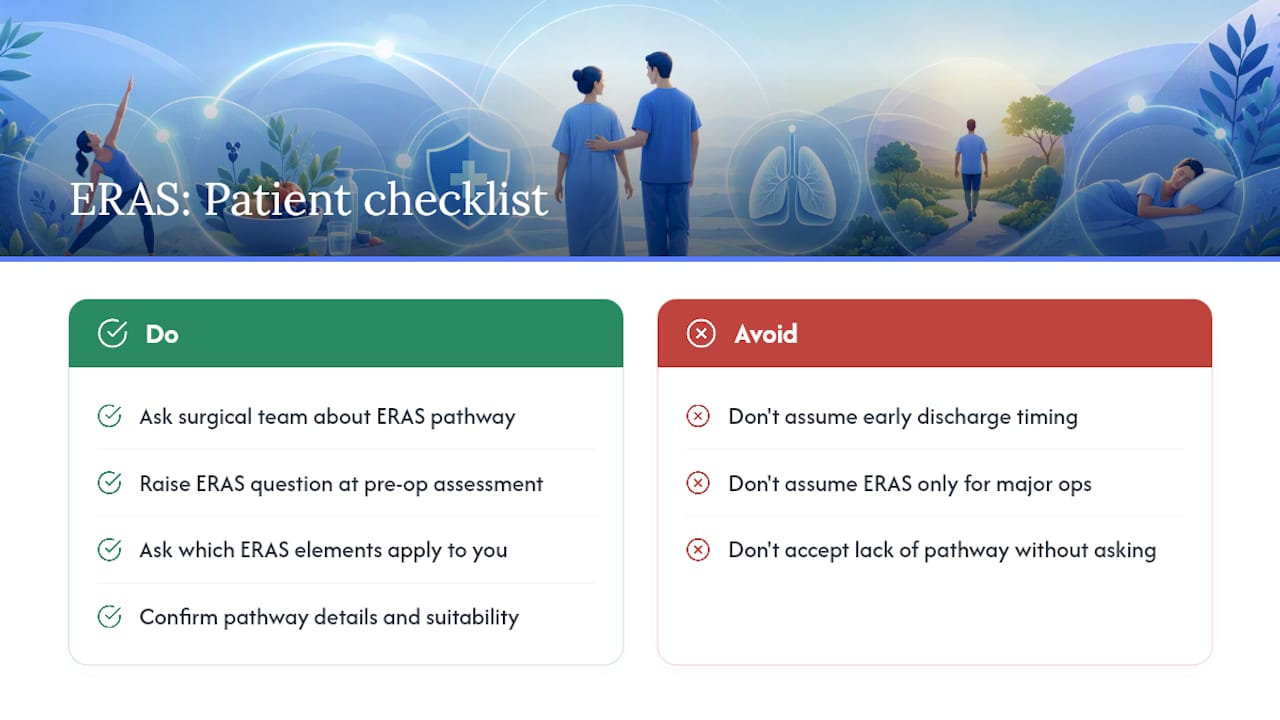
A short checklist worth bringing to your pre-op appointment:
- Which specific ERAS elements does this hospital apply for my procedure?
- What is my realistic expected discharge date, and what determines it?
- What pain control plan will I be on, and how does it change day by day?
- Who do I contact if I have concerns after I’m discharged?
- Will I be given an enhanced recovery diary or similar tool to track my progress?
That last point matters more than it sounds. Many hospitals provide a recovery diary so patients can log mobilisation, diet and pain scores themselves, which both improves adherence and gives you a sense of control at a time that can otherwise feel disorientating.
When is enhanced recovery not appropriate?
Enhanced recovery isn’t a one-size-fits-all prescription, and no reputable clinician applies it rigidly regardless of a patient’s condition. Certain situations call for individualised adaptation or, in some cases, setting the standard pathway aside altogether:
- Unstable medical conditions, such as uncontrolled cardiac or respiratory disease, where the priority is stabilisation before mobilisation targets matter.
- Complex emergency surgery, particularly where sepsis, major bleeding or contamination make early feeding or rapid mobilisation unsafe.
- Severe malnutrition or frailty, where optimisation needs to happen over a longer timeframe than a standard preoperative window allows.
- Certain paediatric and neonatal cases, where age-specific protocols take priority over adult ERAS frameworks.
If you’re recovering at home earlier than traditional care models would have discharged you, clear safety information matters. Red-flag symptoms that warrant prompt contact with your surgical team include worsening pain despite medication, fever, wound redness or discharge, persistent vomiting, or any sudden shortness of breath. Early discharge only works well when it’s paired with a clear safety net, not just a shorter stay.
Pro Tip: Keep your discharge letter and a note of your surgical team’s direct contact details somewhere accessible, not just filed away. If a red-flag symptom appears at 2am, you don’t want to be searching for a phone number.
Why this pathway matters when choosing a clinic
Enhanced recovery is a good test of any clinic, because informed decisions beat vague reassurance every time. When you’re weighing up a procedure, whether that’s orthopaedic surgery or another major operation, knowing exactly what recovery pathway a clinic follows tells you far more than a glossy brochure ever could.
If you’re planning care with any provider, ask directly whether they operate a formal ERAS pathway or apply elements informally. Ask what their typical discharge timeline looks like for your specific procedure, and get clarity on what aftercare is actually included, not just implied. Variation between hospitals is real, and the only way to know what you’re getting is to ask before you book, not after you’ve arrived.
Our 15 questions to ask a clinic include the aftercare questions worth raising before you commit to a date. Thera Travel never recommends a clinic. If you are weighing up a particular clinic abroad, see what the official records say about it, free.
Frequently asked questions
What is an enhanced recovery protocol in simple terms? It’s a coordinated care plan that gets you optimised before surgery, minimises physical trauma during the operation, and gets you eating, drinking and moving again as fast as safely possible afterwards, all aimed at cutting complications and shortening your hospital stay.
How does enhanced recovery work if I’ve never heard of it before my operation? Ask your surgical team directly whether your hospital runs a formal ERAS pathway for your procedure. Most patients only encounter the term at their pre-op assessment, so it’s a completely normal question to raise.
Does enhanced recovery mean I’ll be discharged too early? No. Discharge timing under ERAS is based on meeting specific recovery milestones, not an arbitrary calendar date. If you’re not eating, mobilising or managing pain adequately, discharge gets delayed regardless of the pathway’s usual timeline.
Is enhanced recovery only for major operations? It’s most established for major elective surgery, colorectal, orthopaedic, gynaecological and urological procedures among them, but many of its principles, like early mobilisation and multimodal pain control, apply more broadly across surgical care.
What if my hospital doesn’t seem to follow a full enhanced recovery programme? That’s worth raising directly with your surgical team. Ask which specific elements they apply and why others aren’t part of your plan, since some adaptation is appropriate for certain medical conditions, but a lack of any structured pathway is worth understanding before your operation date.
This article provides general information about enhanced recovery protocols and is not a substitute for personalised medical advice. Always confirm current pathway details and suitability for your specific procedure with your surgical team.
Sources
The ERAS® Society publishes the primary clinical guidelines that most hospital pathways are built on, covering procedure-specific recommendations across more than a dozen surgical areas. The NHS enhanced recovery page offers a patient-facing explanation of what to expect, including the recovery diary concept and everyday practical detail. NICE’s evidence document covers implementation variation and the importance of patient experience as an outcome measure in its own right. For the clinical evidence base, the PMC systematic review on ERAS protocols and the implementation-focused review both offer a more technical look at outcomes and the practical barriers hospitals face rolling the pathway out consistently.
- Home - ERAS® Society
- Enhanced recovery - NHS
- NICE: Evidence for enhanced recovery programmes (NG180 evidence document)
- Enhanced recovery after surgery: implementing a new standard of surgical care - PMC
Recommended
- Hair Transplant Recovery Timeline: Day by Day (2026) | Thera Travel
- Exercises After Knee Replacement | Recovery Exercises for Knee Replacement
- Benefits of Coordinated Travel and Surgery Packages
- Hip Replacement Recovery Time And How to Heal Quicker | Thera Travel

Written by Saher Shodhan
Saher Shodhan is the founder of Thera Travel, which publishes what the official records show about clinics abroad, each fact with the date it was checked, and answers patients' enquiries, free. More about Thera → How we write and check our guides →
Related posts

Cross Border Directive: how to get the HSE to refund treatment abroad
Hip and knee replacement abroad from Ireland: costs, waits and HSE refunds