

Best medical travel options for NHS patients
2026 guide
Home › Guides › Best medical travel options for NHS patients: 2026 guide

Most NHS patients cannot use the S2 funded route, so going abroad means paying for treatment yourself. The three biggest risks of doing that are a surgeon you have not checked, costs that were not in the quote, and no plan for what happens when you get home. All three can be reduced before you pay anything: check the clinic on its official register, check the surgeon by name, read the reviews and get the price itemised in writing. Discuss your plans with your GP before you book.
Table of Contents
- What are the best medical travel checks before you book?
- How does NHS-funded treatment abroad (S2) differ from self-funded options?
- Which countries do UK patients use for specific procedures?
- How do you verify a clinic and surgeon before you book?
- What do all-in costs and timelines actually look like?
- What risks and aftercare realities should you expect?
- What should an agency or marketplace show you?
- What questions should you ask a clinic before you pay?
- Key takeaways
- Why the conventional wisdom on medical travel gets the risk backwards
- How to check a clinic before you book
- Useful sources and further reading
Ask us about treatment abroad, free
Tell us what you're looking into. We send your enquiry to relevant, pre-vetted clinics, and up to 3 that can help contact you directly.
Thera is free for patients. No clinic can pay to change the prices we publish.
What are the best medical travel checks before you book?
Run through these ten points before you pay a penny.
- S2 eligibility. Check whether your condition qualifies for NHS-funded treatment abroad before assuming you must self-fund.
- Clinic accreditation. Confirm JCI accreditation or the national equivalent for your destination country.
- Surgeon registration. Request the surgeon’s registration number and verify it on the relevant national medical register.
- Written treatment plan. Obtain a detailed plan before you pay any deposit.
- Aftercare and complication policy. Confirm in writing who pays for revision surgery, dressings, and re-hospitalisation.
- Explicit exclusions. Read what the package does not cover, not just what it does.
- Insurance specifics. Standard travel insurance excludes elective procedure complications; buy specialist medical complication cover.
- Realistic recovery time. Factor in the recommended no-fly interval for your procedure before booking flights home.
- Total all-in cost in pounds. Convert every figure to sterling, including contingency for complications.
- GP sign-off. Discuss your plans with your GP and get a referral letter or summary to take abroad.
Two immediate red flags: a clinic that advertises surgery without a prior surgeon consultation, or one that pressures you to pay a non-refundable deposit before you have spoken to the operating surgeon.
Pro Tip: When buying medical complication cover, ask specifically whether the policy covers revision surgery, extended in-country stays, and medical evacuation. Many policies that mention “surgery abroad” still exclude elective procedures in the small print.
How does NHS-funded treatment abroad (S2) differ from self-funded options?
The S2 route is the only official mechanism for NHS-funded planned treatment abroad, and it is narrow. It covers state-provided healthcare in EEA countries or Switzerland only, requires prior authorisation from NHS England or your Integrated Care Board (ICB), and never covers dental, cosmetic, or private clinic procedures. The NHS has funded some overseas treatments under specific agreements where waiting lists have become extreme, but these cases require prior authorisation and remain uncommon.
What S2 does not cover matters just as much:
- Travel, accommodation, and translation costs remain your responsibility.
- Repatriation and complication-related expenses are not reimbursed.
- Treatment outside Europe (India, Thailand, Turkey) falls entirely outside S2 scope.
- Private clinic treatment, even in an EEA country, is excluded.
To check eligibility, contact NHS England or your ICB with a clinician’s letter confirming your diagnosis and the proposed treatment. Your GP can help you frame the request. If S2 is declined or simply does not apply to your procedure, self-funding is the practical alternative, and the checks below matter all the more. Read more about how overseas surgery approval works before you start the paperwork.
Which countries do UK patients use for specific procedures?

There is no single best country. The right destination depends on your procedure, your tolerance for a longer flight post-operatively, and the accreditation standards in that market. The table below maps common procedures to their value leaders.
| Procedure | Primary destinations | Relative cost vs UK private | Typical flight time |
|---|---|---|---|
| Hair transplant | Turkey | Very low | 3–4 hrs |
| Dental implants / veneers | Turkey, Hungary, Poland | Low | 3–5 hrs |
| Cosmetic surgery | Turkey, Northern Cyprus | Low–medium | 3–4 hrs |
| IVF / fertility | Spain, Northern Cyprus | Medium | 2–4 hrs |
| Orthopaedic surgery | India, Turkey, Poland | Low–medium | 8–10 hrs (India) |
| Cardiac procedures | India, Thailand | Low–medium | 9 hours |
Already have a clinic in mind? See what the official records say about it →
Turkey leads for hair, dental, and cosmetic work; Hungary and Poland are strong alternatives for dental; Spain and Northern Cyprus attract fertility patients; India and Thailand handle complex orthopaedic and cardiac cases at significant savings. These are self-funded options. Verify clinic-level accreditation and outcomes independently for every destination.
Pro Tip: For major surgery such as orthopaedic or cardiac procedures, choose the closest accredited option you can find. A shorter flight reduces post-operative thrombosis risk and makes an emergency return to the UK faster. See our guide to orthopaedic surgery abroad for a detailed breakdown.
How do you verify a clinic and surgeon before you book?
Insist on a surgeon-led consultation and documented credentials before you commit to anything.
- Request the surgeon’s CV including qualifications, specialist training, and years of practice in the relevant procedure.
- Verify registration on the national medical register for the destination country (e.g. the Turkish Medical Association, the Hungarian Medical Chamber).
- Confirm accreditation. Ask for the clinic’s JCI certificate or national equivalent and check the accreditation body’s website directly.
- Request complication rates for your specific procedure in writing.
- Obtain a written contract specifying who pays for complications, dressings, medications, and re-hospitalisation.
- Check patient reviews on independent platforms. NaTHNaC guidance recommends a direct video or telephone consultation with the actual operating surgeon, not a coordinator.
If a clinic refuses to provide surgeon credentials, complication data, or a written contract, walk away. That refusal is itself the answer. Authentic reviews on Google and independent patient forums carry more weight than testimonials hosted on the clinic’s own website.
What do all-in costs and timelines actually look like?
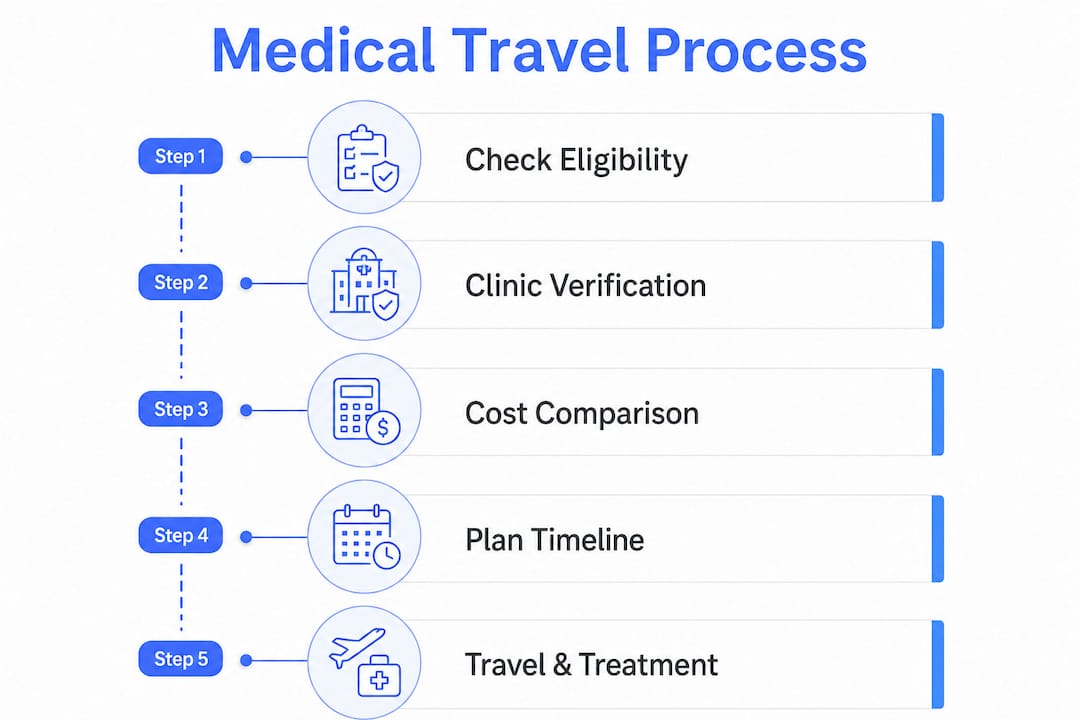
Significant savings are common, but only when you compare every cost in pounds, not just the procedure fee.
| Cost element | UK private estimate | Abroad (e.g. Turkey/Hungary) |
|---|---|---|
| Procedure fee | £3,000 | £800 |
| Flights (return) | N/A | £100 |
| Accommodation (7 nights) | N/A | £400 |
| Medical complication insurance | N/A | £150 |
| Contingency (10–15%) | N/A | £150 |
The timeline to plan for: pre-op blood tests and GP letter before travel, an in-country stay depending on procedure, a recommended no-fly interval that varies by surgery type, and at least one follow-up appointment on return. Budget a contingency of 10–15% of the total for unexpected costs.
What risks and aftercare realities should you expect?
The NHS will provide emergency care when you return, but it is not obliged to offer routine follow-up for a private procedure done abroad. Plan your aftercare before you travel.
- Fragmented care. NaTHNaC warns that aftercare gaps and delayed complications are common reasons medical tourists need emergency treatment on return.
- Infection and wound complications. These often present after you are home, when the overseas clinic is unreachable.
- Thrombosis. Long-haul flights post-operatively carry a genuine clot risk; follow your surgeon’s no-fly guidance strictly.
- Language and communication. Miscommunication about medications or post-op instructions is a documented hazard.
- Limited legal recourse. Complaints and negligence claims against overseas clinics are difficult and expensive to pursue from the UK.
- Insurance gap. Standard travel insurance excludes elective procedure complications; specialist medical complication cover is not optional.
To prepare your GP for post-op handover, bring a full discharge summary in English, a list of medications prescribed, wound care instructions, and the clinic’s contact details. Your GP is more likely to engage with follow-up care when the documentation is complete.
What should an agency or marketplace show you?
If you use an agency or an online marketplace rather than booking direct, it should be able to show you the same things a clinic would. Ask for them before you enquire.
- The clinic’s legal name and its entry on the country’s official register.
- The operating surgeon’s name and registration number, so you can look them up yourself.
- Reviews from an independent source such as Google, not only testimonials on its own site.
- An itemised price that says what is included, such as flights, accommodation, transfers or a translator, and what is not.
- Written handover documents for your UK GP, and who to contact if something goes wrong at home.
Also ask how the agency is paid. Some are paid by the clinics they send patients to, which is worth knowing when it suggests one clinic over another.
What questions should you ask a clinic before you pay?
Ask these before you sign anything.
- Will I have a direct consultation with the operating surgeon before the day of surgery?
- Can you provide the surgeon’s registration number and CV?
- What is the clinic’s JCI or national accreditation status?
- What is included in the package price, and what is explicitly excluded?
- Who pays for revision surgery, dressings, and re-hospitalisation if complications arise?
- What aftercare is provided in-country, and for how long?
- What happens if I need repatriation for medical reasons?
- What are the payment terms, and what is the refund policy if I need to cancel?
- Will you provide a written contract before I pay any deposit?
- Can you supply a discharge summary in English for my UK GP?
Non-negotiable in writing: the written treatment plan, the complication and revision policy, the itemised package price, and the surgeon’s credentials. If a clinic or marketplace cannot produce these, treat it as a red flag.
Key takeaways
For NHS patients who cannot access S2, self-funded treatment abroad is an option, provided you check the clinic and surgeon yourself, get the price itemised and plan your GP handover before you go.
| Point | Details |
|---|---|
| Check S2 eligibility first | S2 is the only NHS-funded route; it covers EEA state providers only and excludes dental, cosmetic, and private clinics. |
| Check the clinic yourself | Look up the clinic’s official register entry, the surgeon’s registration and the reviews, whoever suggested the clinic. |
| Buy specialist insurance | Standard travel insurance excludes elective procedure complications; medical complication cover is non-negotiable. |
| Insist on a surgeon consult | Never book without a direct consultation with the operating surgeon and a written contract. |
| Plan the handover home | Bring an English discharge summary, medication list and wound care instructions for your GP. |
Why the conventional wisdom on medical travel gets the risk backwards
Most articles about medical travel abroad focus on the financial risk: what if the clinic overcharges, what if the quote changes? That is the wrong thing to worry about first. The real exposure is clinical, and it almost always surfaces after you are home.
The patients who run into serious trouble are rarely the ones who paid too much. They are the ones who flew home four days after a major procedure because the package said they could, arrived back with a wound infection or a deep vein thrombosis, and found their GP had no discharge summary and no idea what had been done. The NHS will treat the emergency. It will not necessarily manage the recovery.
The practical fix is not complicated: extend your in-country stay beyond the minimum, carry a full English-language discharge summary, and brief your GP before you travel. Ask the clinic before you book what GP handover documents it provides, and get the answer in writing. That is the part most patients forget to plan.
How to check a clinic before you book
A clinic’s own website will always say it is excellent. These five checks show you what the records say instead.
- The official register. Find the clinic on its country’s official register, under the legal name on the quote.
- The surgeon. Get the operating surgeon’s name in writing and look them up on their professional register.
- The reviews. Read them, including the low-rated ones, and check which Google listing is the actual hospital.
- The price. Get the quote itemised in writing, with what is included and what is not.
- Coming home. Ask what happens if something goes wrong once you are back in the UK.
Our 15 questions to ask a clinic goes further. Thera Travel does not recommend a clinic. If you have a clinic in mind, you can see what the official records say about it for free. For spine patients, our guide to endoscopic spine surgery abroad covers the procedure and recovery.
Pro Tip: Have your GP referral letter, a recent blood test summary, and any imaging reports ready when you contact a clinic. Clinics can give you a faster, more accurate quote when they can review your clinical history upfront.
Useful sources and further reading
- NHS: going abroad for medical treatment — Start here for an overview of S2 and EU directive routes, EHIC/GHIC limitations, and the NHS’s general guidance on self-funded treatment.
- NHS: planned treatment S2 funding route — Definitive source for S2 eligibility criteria, prior authorisation process, and what the route does and does not cover.
- NHS: treatment abroad checklist — Use this before booking: covers GP involvement, documentation, insurance, and aftercare arrangements.
- NaTHNaC: medical tourism factsheet — The most thorough UK-facing clinical guide to medical travel risks, insurance gaps, and aftercare planning. Read it before you book any elective procedure abroad.
- NHS inform: surgery abroad without NHS referral — Scottish NHS guidance on no-fly intervals, surgeon consultation requirements, and the risks of packaged surgical offers.
- NHS: Healthcare Travel Costs Scheme — Check whether you qualify for domestic travel cost reimbursement when attending NHS appointments in the UK.
Recommended
- What Is Medical Tourism? A 2026 Patient Guide
- Overseas Treatment Options: Your 2026 Patient Guide
- Medical Tourism in Turkey: 2026 Guide to Costs & Safety | Thera Travel
- Dental Tourism: The 2026 UK Patient Guide | Thera Travel

Written by Saher Shodhan
Saher Shodhan is the founder of Thera Travel, which publishes what the official records show about clinics abroad, each fact with the date it was checked, and answers patients' enquiries, free. More about Thera → How we write and check our guides →
Related posts

Cross Border Directive: how to get the HSE to refund treatment abroad
Hip and knee replacement abroad from Ireland: costs, waits and HSE refunds