

International treatment pathways explained for UK patients
Home › Guides › International treatment pathways explained for UK patients

An international treatment pathway is the structured sequence of steps a UK patient follows to access, fund, and complete medical treatment in another country. Three main routes exist: the S2 (planned treatment) scheme, where your home NHS institution covers costs directly at a public hospital abroad; EU cross-border prior authorisation, where you pay upfront and claim reimbursement at UK public tariff rates; and private pay-and-claim, where you self-fund and recover costs through private insurance. Your first call should go to your GP, your insurer, or the UK National Contact Point, depending on which route fits your situation.
Main routes at a glance:
- S2 scheme — NHS-funded, prior authorisation required, public hospitals only
- EU cross-border / prior authorisation — pay upfront, claim back at public tariff
- Private pay-and-claim — self-fund, recover through private health insurance
Table of Contents
- What are the main funding routes for UK patients going abroad?
- Who qualifies, and what documents do you need?
- Costs and reimbursement: what you pay and what you get back
- Step-by-step checklist for organising treatment abroad
- What safety risks should you check before booking?
- Where to get official help: NHS contacts and national contact points
- How to check a clinic before you book
- Key takeaways
- The part of this process most patients underestimate
- Seeing what the records say about a clinic
- Official guidance and further reading
Ask us about treatment abroad, free
Tell us what you're looking into. We send your enquiry to relevant, pre-vetted clinics, and up to 3 that can help contact you directly.
Thera is free for patients. No clinic can pay to change the prices we publish.
What are the main funding routes for UK patients going abroad?
Organising planned medical treatment in another EU country sets out the legal framework clearly. Each route works differently in practice.
S2 scheme. With an S2 form, your NHS institution covers the costs of planned treatment at a public hospital in another EU or EEA country directly. You do not pay upfront; the hospital bills your home institution. Prior authorisation is mandatory before you travel, and you can only access publicly provided healthcare under this route. The S2 scheme is typically granted when the treatment is covered by the NHS but cannot be provided within a medically justifiable waiting time.
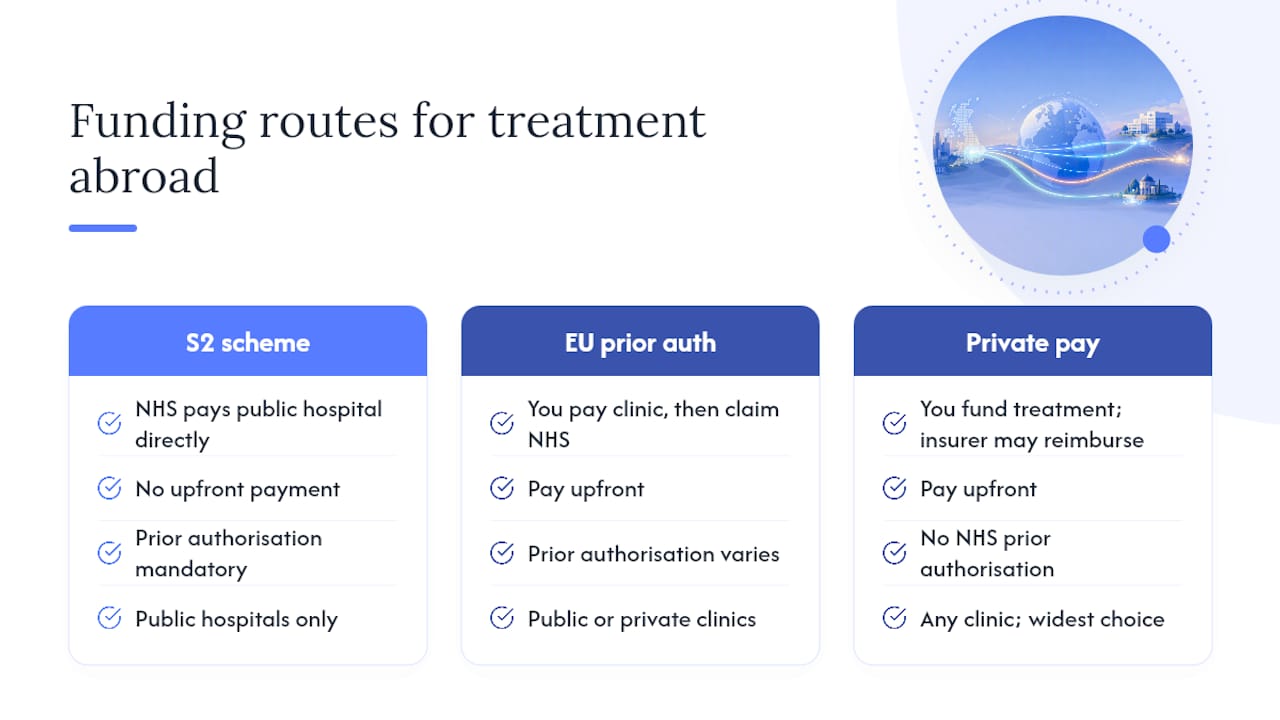
EU cross-border / prior authorisation. Under this route, you pay the clinic directly, then claim reimbursement from the NHS. Reimbursement is calculated at UK public tariff rates, not at what you actually paid, so a private clinic abroad charging more than the NHS equivalent will leave you with a shortfall. Prior authorisation rules vary by treatment type.
Private pay-and-claim. You fund treatment entirely yourself and recover costs through private medical insurance. Reimbursement depends entirely on your policy terms. This route offers the widest choice of clinics and countries but carries the greatest financial exposure if complications arise.
One point worth stressing: your EHIC or GHIC does not cover planned treatment abroad. Those cards only cover necessary healthcare that arises unexpectedly while you are visiting and cannot wait until you return home. Using a GHIC for a pre-arranged procedure is not valid.
Who qualifies, and what documents do you need?
Eligibility for the S2 scheme or prior authorisation generally requires that you are an insured UK resident, that the treatment is covered by the NHS, and that it cannot be provided at home within a medically justifiable waiting time. The NHS guidance on going abroad for medical treatment outlines the authorisation process in detail.
Documents you will typically need to submit:
- GP or consultant referral letter confirming diagnosis and clinical need
- Written description of the planned procedure and its clinical urgency
- Evidence that equivalent treatment is unavailable locally within an acceptable timeframe
- Cost estimate from the overseas clinic
- Proof of NHS registration or UK health insurance
- Passport or proof of identity
Ask your GP or consultant to state the procedure name, the clinical urgency, and the estimated waiting time in the UK explicitly. Vague referral letters are the most common cause of delayed decisions. Decisions on S2 applications can take several weeks, so apply as early as possible once your treatment plan is confirmed. For a detailed look at the overseas surgery approval process, the overseas surgery approval guide covers the steps in plain language.
Costs and reimbursement: what you pay and what you get back
The pay-upfront-then-claim model applies to most cross-border routes. Under the S2 scheme, you avoid this entirely because the hospital bills the NHS directly. Under prior authorisation or private pay-and-claim, you settle the clinic invoice yourself and then submit a claim.
The critical distinction: reimbursement under the cross-border route is capped at the UK public tariff for the equivalent procedure. If a clinic in Spain charges €4,000 for a procedure the NHS values at £2,500, you recover £2,500 and absorb the rest. Private insurance may cover the gap, but only if your policy explicitly includes treatment abroad.
| Scenario | Who pays upfront | Reimbursement basis |
|---|---|---|
| S2 scheme | NHS pays clinic directly | Full public cost covered |
| EU cross-border prior authorisation | Patient pays clinic | UK public tariff rate |
| Private pay-and-claim | Patient pays clinic | Per private insurance policy terms |
Already have a clinic in mind? See what the official records say about it →
Insurance checklist before you book:
- Medical evacuation and repatriation cover
- Emergency treatment cover during travel
- Complication and revision surgery cover
- Follow-up care on return to the UK
- Cover for pre-existing conditions related to the procedure
The CDC guidance on medical tourism recommends purchasing travel health insurance that explicitly includes medical evacuation cover, as standard travel policies routinely exclude it.
Step-by-step checklist for organising treatment abroad
The European Commission’s planned treatment checklist provides a clear sequence. Follow these steps in order.
- Check your cover and speak to your GP or insurer. Confirm whether your treatment qualifies for S2 or prior authorisation, or whether you are self-funding.
- Collect your clinical records and referrals. Gather diagnosis letters, imaging reports, and a referral from your consultant. Request copies of everything in writing.
- Decide on your route. S2 if the NHS will fund it; prior authorisation if you want to pay and claim; private pay-and-claim if you are self-funding.
- Verify clinic credentials. Check national registration, surgeon qualifications, and whether the clinic reports outcomes publicly. The clinic verification guide covers what to look for.
- Book treatment and plan travel and aftercare. Confirm the procedure date, arrange flights and accommodation, and identify a UK clinician who will manage your follow-up.
- Document everything. Keep original receipts, operative notes, discharge summaries, and prescription records. These are required for reimbursement and for continuity of care when you return.
Clinic verification sub-checklist:
- Confirmed registration on the national medical register
- Surgeon’s qualifications and specialty credentials
- Accreditation by a recognised body (e.g., JCI or national equivalent)
- Publicly available outcome or complication data
- Verified patient reviews from a traceable source
Travel and medication documentation:
- Carry a clinician letter listing your conditions, medications, and allergies
- Record generic drug names alongside brand names
- Keep digital copies of all records accessible offline
Pro Tip: Scan and upload originals to a secure cloud folder before you travel. Original receipts and operative notes are the two documents most commonly missing from reimbursement claims, and their absence can delay or invalidate a claim entirely.
What safety risks should you check before booking?
Standards vary considerably between countries and between clinics within the same country. The most common risks are inconsistent infection control, difficulty arranging follow-up care for complications, and exposure to substandard or falsified medicines.
Quality markers to verify before you book:
- National registration of the clinic and lead surgeon
- International accreditation where applicable (JCI is the most widely recognised)
- Transparent complication and revision rates
- A clear protocol for managing post-operative complications remotely
- Pharmacy sources verified as licensed and regulated
The NCBI travel medicine guidance advises patients with complex conditions to carry a clinician letter and keep copies of all treatment received abroad for continuity of care. If you take regular medication, bring a larger supply than you expect to need, and verify that any medication purchased abroad comes from a licensed pharmacy. The WHO estimates that 1 in 10 medical products in low- and middle-income countries is substandard or falsified, so sourcing medication from verified pharmacies is not optional.
Where to get official help: NHS contacts and national contact points
Your first contact depends on your route. For S2 applications, start with your GP, who refers you to NHS England or the relevant devolved health authority. For prior authorisation queries, contact NHS England’s overseas healthcare team directly. For general guidance on cross-border rights, the UK National Contact Point handles enquiries from UK residents.
When you call, have the following ready: the exact procedure name, your diagnosis, the clinical urgency, and whether equivalent treatment is available locally. Vague enquiries take longer to resolve.
Official resources:
- NHS guidance on going abroad for treatment — start here for UK-specific process and authorisation
- Your Europe planned healthcare page — S2 and cross-border rights explained
How to check a clinic before you book
Whichever funding route you take, the clinic is your choice and your risk. These five checks take an evening and catch most problems.
- Find the clinic on its country's official register, under the legal name printed on your quote. A trading name on a website is not enough.
- Get the surgeon's name in writing and look them up on their professional register.
- Read the reviews, including the low-rated ones. Check which Google listing is the actual hospital, not an agent or a sister clinic.
- Get the quote itemised in writing: what is included, what is not, and what triggers extra charges. You will need it for any reimbursement claim.
- Ask what happens if something goes wrong once you are home, and who pays.

Our 15 questions to ask a clinic turn these into an email you can send, and how we check a clinic explains which registers we use.
Key takeaways
An international treatment pathway for UK patients runs through one of three routes: S2 (NHS-funded, prior authorisation required), EU cross-border (pay upfront, claim at UK tariff), or private pay-and-claim (self-funded, insurance-dependent).
| Point | Details |
|---|---|
| Three routes available | S2, EU cross-border prior authorisation, and private pay-and-claim each work differently for funding and eligibility. |
| GHIC/EHIC does not apply | Neither card covers planned treatment; they only cover unexpected medical needs during a visit. |
| Documents are critical | A referral letter, diagnosis, procedure description, cost estimate, and proof of NHS registration are the core submission. |
| Verify clinics before booking | Check national registration, surgeon credentials, accreditation, and verified patient reviews before committing. |
| Plan the return home | Make sure your UK GP will receive a full clinical summary, and keep operative notes and receipts for your claim. |
The part of this process most patients underestimate
Many patients spend weeks researching destinations and procedures before they contact anyone official. That instinct is understandable, but it tends to create problems later. The S2 application, the referral letter, the clinical urgency statement — these need to come from your GP or consultant, and they need to be written in a specific way. A letter that says “patient wishes to have surgery abroad” is not the same as one that documents the procedure name, the clinical urgency, and the waiting time in the UK. The difference between those two letters can be the difference between an approved application and a rejected one.
The other thing people consistently underestimate is aftercare. Treatment abroad is often excellent. The gap appears when you return home and need a GP or physiotherapist to continue your care, and they have no operative notes, no discharge summary, and no way to contact the treating surgeon. Carry everything in writing, keep digital copies, and confirm before you leave the clinic that your UK GP will receive a full clinical summary.
Seeing what the records say about a clinic
Patients who decide to self-fund abroad often spend weeks checking clinics, chasing quotes and working out what a package price actually includes. Our procedure guides, such as endoscopic spine surgery and laminectomy abroad, set out typical prices so you know what a fair quote looks like.
Thera Travel does not book treatment or recommend clinics. If you already have a clinic in mind, look it up free to see what the official records say.
Official guidance and further reading
Use these sources for authoritative information on forms, rights, and safety:
- NHS: going abroad for medical treatment — start here for UK authorisation and reimbursement process
- Your Europe: planned healthcare rights — S2 form, prior authorisation, and cross-border reimbursement rules
- CDC: medical tourism — pre-travel preparation, insurance, and follow-up care recommendations
- NCBI: health care abroad — documentation and medication guidance for complex conditions
- SIP Medical: international patient journey map — overview of the four common routes patients use to access care abroad
This article provides general information about international treatment pathways and is not a substitute for professional medical or legal advice. Confirm current eligibility rules and authorisation requirements with the NHS, your GP, or the relevant National Contact Point before making any arrangements.
Recommended
- Hidden costs of medical tourism: a checklist
- How international hospital standards work
- Managing family logistics during medical travel
- What is overseas orthopaedic surgery?

Written by Saher Shodhan
Saher Shodhan is the founder of Thera Travel, which publishes what the official records show about clinics abroad, each fact with the date it was checked, and answers patients' enquiries, free. More about Thera → How we write and check our guides →
Related posts

Cross Border Directive: how to get the HSE to refund treatment abroad
Hip and knee replacement abroad from Ireland: costs, waits and HSE refunds