

International health insurance for UK patients
2026 guide
Home › Guides › International health insurance for UK patients: 2026 guide
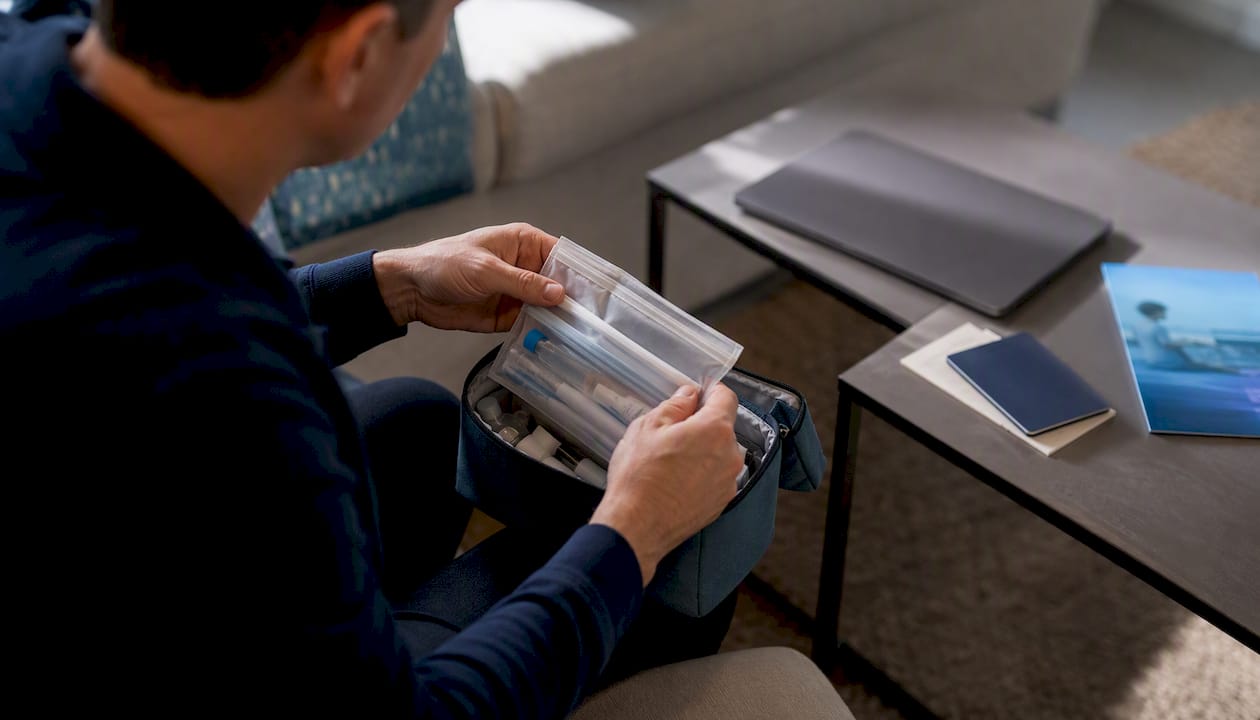
In the context of medical tourism, “international health insurance” refers to an organised marketplace model that helps UK patients find, compare, and book elective procedures at overseas clinics, with packages that typically bundle surgery, travel, and aftercare into a single arrangement. This is not the same as international private medical insurance (IPMI), which is ongoing cover for expatriates living abroad. If you are a UK patient facing a long NHS waiting list for a hip replacement, dental implants, or cosmetic surgery, this guide is written for you. Before booking anything, speak to your GP and arrange specialist travel insurance that explicitly covers elective procedures.
Key takeaways
Arranged international treatment can deliver real savings and faster access, but only when patients verify credentials, secure specialist insurance, and plan aftercare before they travel.
| Point | Details |
|---|---|
| GHIC/EHIC do not cover planned treatment | Arrange specialist travel insurance that explicitly covers your elective procedure and complications. |
| Verify surgeon and clinic independently | Check the surgeon against the GMC or national equivalent and confirm JCI accreditation directly. |
| Written contract is non-negotiable | The contract must specify who pays for complications, follow-up care, and any extended stay. |
| Plan UK aftercare before you travel | The NHS is not obliged to provide routine follow-up; book private follow-up in advance. |
| Check the clinic yourself | Look up the clinic’s official register entry, the surgeon’s registration and the Google reviews before you pay anything. |
Already have a clinic in mind? See what the official records say about it →
Ask us about treatment abroad, free
Tell us what you're looking into. We send your enquiry to relevant, pre-vetted clinics, and up to 3 that can help contact you directly.
Thera is free for patients. No clinic can pay to change the prices we publish.
Table of Contents
- What does an international treatment package actually include?
- Benefits versus risks: what you need to weigh honestly
- Your due-diligence checklist before you book
- What does it cost, and what do GHIC and the NHS actually cover?
- Legal realities and continuity of care on return
- Planning your timeline from consultation to recovery
- Is arranged treatment abroad right for you?
- What an arranged package typically includes
- Tax and financial assistance for overseas treatment
- How to compare medical tourism insurance plans
- An honest view on what medical tourism actually delivers
- How to check a clinic before you book
- Sources
What does an international treatment package actually include?
The buyer journey follows a clear sequence: you search and compare clinics, request a remote consultation, receive a quote, confirm the booking, travel, undergo treatment, and then manage aftercare on return. Some patients use an agency for the logistics in between. Whoever arranges the trip, the checks on the clinic itself are worth doing yourself.
A typical all-inclusive package covers:
- Surgeon and theatre fees, plus hospital stay
- Pre-operative testing and consultations (often conducted remotely before travel)
- Airport transfers and accommodation near the clinic
- Post-operative follow-up calls and wound-care instructions
- Optional add-ons: medical evacuation cover, extended in-country nursing, and English-language medical records on discharge
The clinic is responsible for clinical care and staffing. The marketplace or broker verifies credentials, arranges logistics, and connects you with the right facility. You remain responsible for your own travel insurance, your GP relationship in the UK, and any follow-up care once you are home.
Benefits versus risks: what you need to weigh honestly
The primary draws are speed and cost. NHS waiting lists for elective orthopaedic procedures can stretch beyond a year in many trusts, and overseas packages can cost significantly less than equivalent private UK treatment. Access to high-volume specialist centres is a genuine benefit too; some overseas clinics perform procedures at a scale that UK private hospitals rarely match.
The risks are equally real. Travel Aware warns that travelling for treatment increases the risk of complications, and that choosing the lowest-cost option may not be the safest choice. The NHS and the British Association of Aesthetic Plastic Surgeons (BAAPS) consistently flag continuity of care as the single biggest clinical challenge. If something goes wrong after you fly home, your UK GP is not obliged to provide routine follow-up for a procedure arranged privately overseas.
| Factor | Benefit | Risk |
|---|---|---|
| Speed | Weeks, not months or years | Rushing increases error risk |
| Cost | Substantially lower than UK private | Complications can erase savings |
| Specialist access | High-volume centres in some destinations | Standards vary widely by country |
| Continuity of care | Aftercare often included in package | UK GP not obliged to follow up |
| Legal recourse | Package Travel Regulations may apply | Enforcing judgments abroad is difficult |
Pro Tip: Watch for hard-sell tactics from any intermediary that discourages you from meeting the operating surgeon before you pay. Insisting on a video consultation with the actual surgeon, not a patient coordinator, is one of the most effective filters you can apply.
Your due-diligence checklist before you book
- Verify the surgeon’s credentials. Ask for their name and check it against the General Medical Council (GMC) register or the equivalent national register for the destination country. A surgeon practising in Turkey, for example, should be registered with the Turkish Medical Association.
- Check clinic accreditation. Joint Commission International (JCI) accreditation is the most widely recognised international standard. Ask the clinic for its certificate and verify it directly on the JCI website.
- Confirm indemnity insurance. Ask the clinic for written evidence of professional indemnity cover. NaTHNaC guidance specifically recommends checking that the clinic holds adequate indemnity before you sign anything.
- Read authentic patient reviews. Look beyond the clinic’s own website. Google reviews, including the low-rated ones, give a more reliable signal than curated testimonials. Check which Google listing belongs to the actual hospital.
- Ask about complication rates. A reputable surgeon will answer this question directly. Evasion is a red flag.
- Demand a written treatment contract. The contract should specify: the exact procedure, who pays for complications, who provides follow-up care, the language of your medical records, and what happens if you need an extended stay.
- Arrange specialist travel insurance. TravelHealthPro is explicit: standard travel insurance rarely covers planned elective procedures. You need a policy that covers complications, medical evacuation, and repatriation.
- Consult your GP before you travel. Discuss your fitness for surgery, any medication interactions, and destination-specific health advice including vaccinations.
For a step-by-step guide to vetting a medical tourism provider, our guide covers the criteria in detail.
What does it cost, and what do GHIC and the NHS actually cover?
The NHS is clear: your Global Health Insurance Card (GHIC) or European Health Insurance Card (EHIC) covers only necessary emergency care while you are visiting another country. Neither covers planned elective treatment. The NHS is not obliged to reimburse you for privately arranged overseas procedures, and routine follow-up on return is not guaranteed.
There is a limited exception: the S2 route allows NHS funding for certain treatments in EU and EEA countries, but it requires prior authorisation from your NHS commissioner and applies to a narrow set of circumstances. For most patients pursuing elective treatment abroad, this route is not available.
| Cost element | Typical position |
|---|---|
| Surgical package (procedure, theatre, stay) | Paid directly to clinic or via marketplace |
| Specialist travel insurance | Patient’s own responsibility; must cover elective procedures |
| Medical evacuation cover | Often an add-on; confirm before travel |
| UK follow-up (GP, dressings, physio) | Likely out-of-pocket if NHS declines |
| Complications requiring UK hospital care | Out-of-pocket or via specialist insurance |
Plan a contingency fund for UK follow-up costs. If your procedure requires physiotherapy or wound management after you return, budget for private appointments rather than assuming NHS access.
Legal realities and continuity of care on return
Suing an overseas clinic is genuinely difficult. Academic analysis points to information asymmetry, advertising challenges, and the near-impossibility of enforcing judgments across jurisdictions. UK professional safeguards, including GMC registration and Medical Defence Union or Medical Protection Society indemnity, do not automatically apply to foreign practitioners.
The Package Travel and Linked Travel Arrangements Regulations 2018 can offer a route to redress if your booking qualifies as a package, but qualification is not automatic and enforcement across borders remains complex.
Practical steps to protect yourself:
- Request a full medical report in English on the day of discharge, including imaging and pathology results.
- Use your Data Protection Act rights to request copies of all records held by the clinic.
- Before you travel, agree in writing who provides follow-up care and for how long.
- Register the procedure with your UK GP on return so they have a complete clinical picture.
Planning your timeline from consultation to recovery
- Eight or more weeks before travel: Request your NHS medical records, discuss the procedure with your GP, and visit a travel clinic for destination-specific vaccinations and advice.
- Four to six weeks before: Confirm the surgeon’s identity and credentials, sign the written contract, and purchase specialist travel insurance.
- One to two weeks before: Complete any pre-operative blood tests or imaging required by the clinic (often arranged remotely).
- In-country recovery: Allow sufficient time before flying. NHS guidance recommends avoiding flights for 5–7 days after procedures such as breast surgery or liposuction, and 7–10 days after facial or extensive abdominal surgery. Thrombosis risk from long-haul flights is a genuine clinical concern.
- Before departure: Collect your full medical report in English, all medication with documentation, and the clinic’s emergency contact details.
- On return: Book a GP appointment within 48 hours to hand over your medical records and discuss follow-up.
Pack contingency funds for an extended stay. If your surgeon advises against flying on the planned date, you need the financial flexibility to stay longer.
Is arranged treatment abroad right for you?
It may be appropriate if you:
- Are medically fit for travel and surgery, confirmed by your GP
- Are self-funding and have compared total costs including follow-up
- Have researched the clinic, verified the surgeon, and arranged specialist insurance
- Have a clear written aftercare plan for both in-country and UK follow-up
Stop and reconsider if
- You cannot meet or video-call the operating surgeon before paying
- The clinic cannot provide written evidence of indemnity insurance
- You are being pressured to book quickly or pay a non-refundable deposit before seeing a contract
- The recovery timeline offered seems unrealistically short for your procedure
- You have complex medical history that requires close post-operative monitoring
Always consult your GP or specialist before proceeding. Their clinical view of your fitness for travel and surgery is not a formality.
What an arranged package typically includes
Whether you book through a clinic or an agency, the checks that matter are the same: the clinic’s registration on its official medical register, JCI or equivalent accreditation, indemnity documentation and the medical staff’s credentials. Reviews from Google tell you more than testimonials the clinic has chosen itself.
Arranged packages commonly include:
- Pre-operative coordination and a named surgeon
- In-country transfers and accommodation
- English-language medical records provided on discharge
- Aftercare coordination options for the return period
Get the list of what is included in writing, and ask what is not. Our guide to the role of accredited overseas hospitals explains what JCI accreditation actually means in practice. If an agency is involved, ask how it is paid: some are paid a fee by the clinic when you book.
Tax and financial assistance for overseas treatment
For most UK patients, paying for elective treatment abroad is straightforward private expenditure with no special tax treatment. HMRC does not currently offer tax relief on medical expenses for UK residents in the way some other jurisdictions do. If your employer provides a health cash plan or private medical insurance, check the policy wording carefully: some plans include limited overseas treatment benefits or will reimburse diagnostic costs, but elective procedures arranged independently are typically excluded.
If you are self-employed, medical expenses are not deductible against income tax in the UK unless they relate directly to a condition caused by your work. A small number of flexible spending arrangements exist through employer salary sacrifice schemes, but these are employer-dependent and rarely extend to overseas elective surgery.
One practical option worth exploring: some UK credit providers offer 0% purchase periods that can spread the cost of a package over 12–24 months interest-free, provided you clear the balance before the promotional period ends. Section 75 of the Consumer Credit Act 1974 also gives you a claim against your credit card provider if a service costing between £100 and £30,000 is not delivered as contracted, which adds a layer of financial protection when paying by credit card.
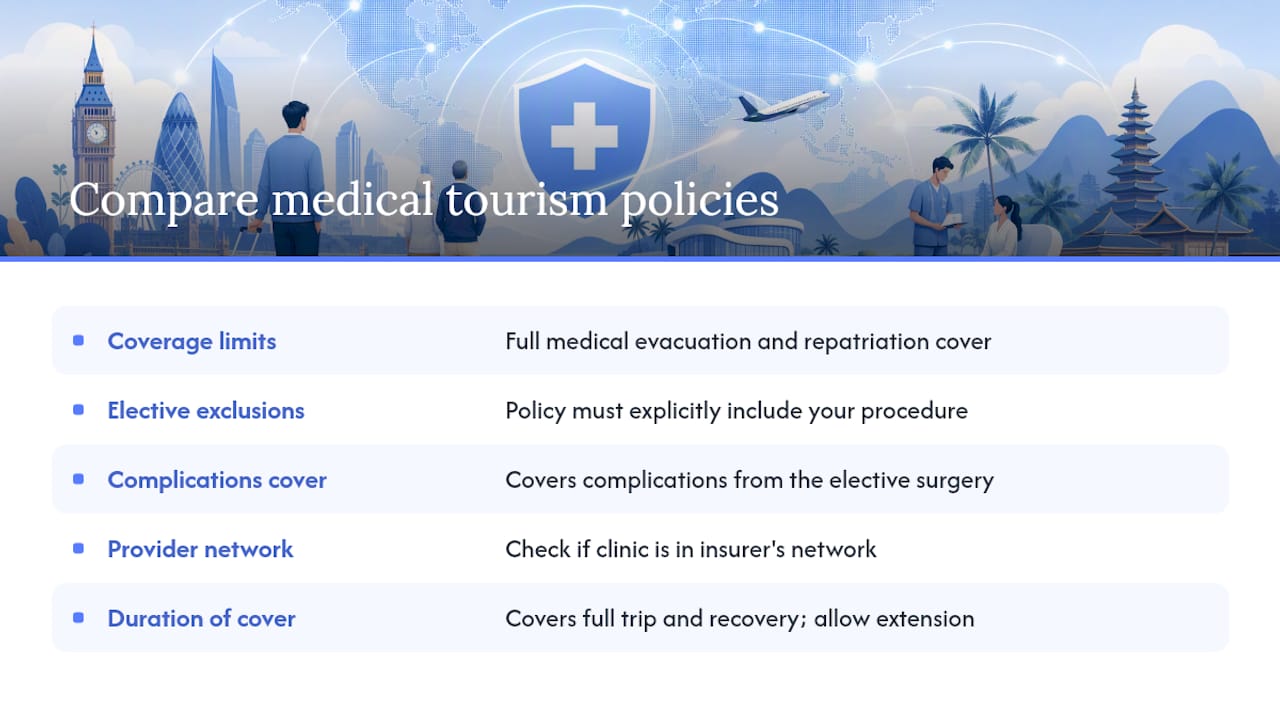
How to compare medical tourism insurance plans
The phrase “international health insurance” is used loosely in the market. For medical tourism, what you actually need is a specialist travel medical policy designed for elective procedures, not a standard annual travel policy and not an IPMI plan.
When comparing policies, assess these criteria:
Coverage limits: The policy should cover the full cost of medical evacuation and repatriation, which can run to tens of thousands of pounds. A low headline premium with a low evacuation limit is a false economy.
Elective procedure exclusions: Read the exclusions list carefully. Many standard policies exclude any treatment that was known about or planned before the policy was purchased. You need a policy that explicitly includes your procedure type.
Complications cover: Confirm the policy covers complications arising from the elective procedure itself, not just unrelated emergencies. This is the coverage gap that catches most patients out.
Provider network: Some insurers have preferred hospital networks in specific countries. If your chosen clinic is outside the network, the insurer may require pre-authorisation or pay at a reduced rate.
Duration of cover: Policies should cover the entire trip including the in-country recovery period, not just the surgical date. If your recovery extends beyond the policy end date, you need the ability to extend.
Comparison sites such as those listed on the TravelHealthPro website can point you toward specialist brokers. Always call the insurer directly to confirm your specific procedure is covered before you pay.
An honest view on what medical tourism actually delivers
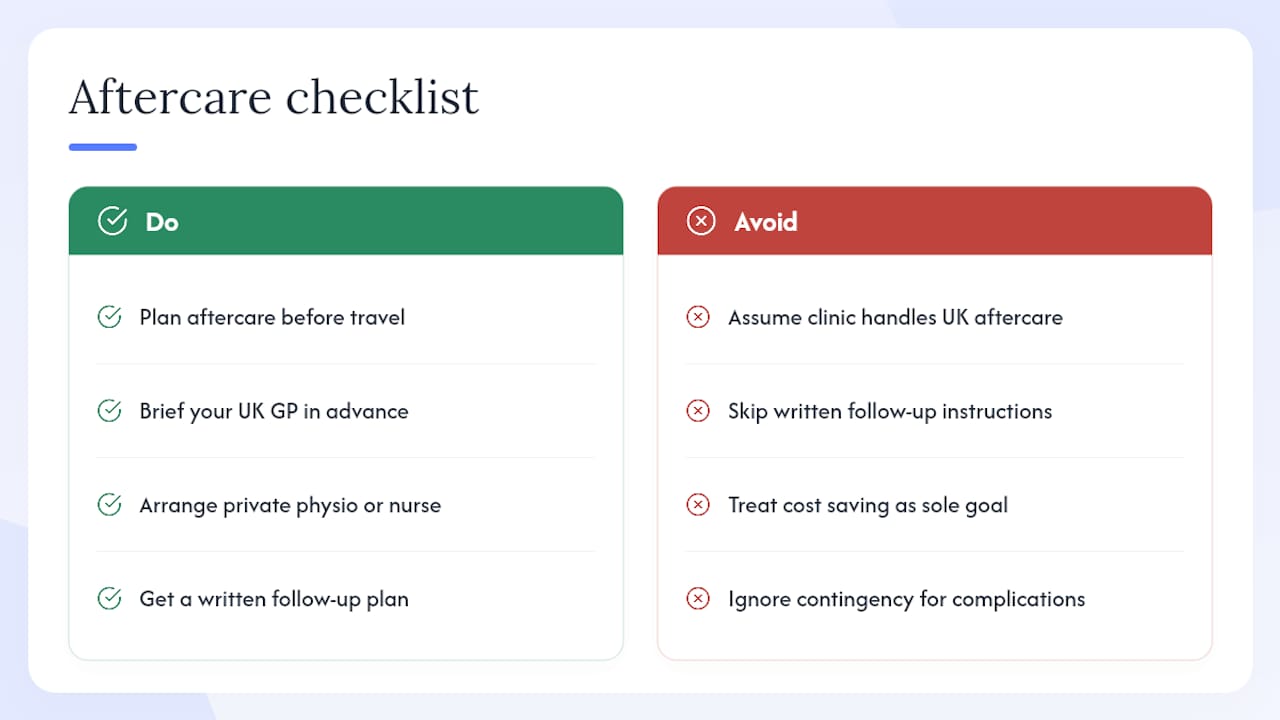
The gap between what arranged overseas treatment promises and what it reliably delivers comes down to one variable: aftercare. The surgery itself, at a well-accredited clinic with a verified surgeon, can be excellent. The problem is what happens in the six weeks after you land back at Heathrow.
Most packages are designed around the in-country experience. The follow-up coordination, the GP handover, the physiotherapy, the wound checks — these are often treated as the patient’s problem to solve. That is not a criticism of overseas clinics specifically; it is a structural feature of the model. Distance makes continuity of care genuinely hard.
The patients who get the best outcomes from treatment abroad are the ones who treat the aftercare planning with the same rigour as the surgical booking. They have a UK GP briefed before they travel. They have a private physiotherapist or specialist nurse lined up for the return. They have a written plan from the overseas surgeon specifying exactly what follow-up is needed and when.
Cost savings are real and can be substantial. But the saving is only realised if the outcome is good. A complication that requires NHS treatment, private follow-up, or a second procedure abroad will erode that saving quickly. The due-diligence checklist in this guide is not bureaucratic caution; it is the difference between a successful outcome and an expensive lesson.
How to check a clinic before you book
NHS waiting lists are a genuine problem, and the cost of UK private treatment puts many procedures out of reach for most families. If you are looking abroad, these five checks come before any deposit:
- Find the clinic on its country’s official register, under the legal name on the quote.
- Get the surgeon’s name in writing and check their professional register.
- Read the reviews, including the low-rated ones, and make sure the Google listing is the actual hospital.
- Get the quote itemised in writing: what is included and what is not.
- Ask what happens if something goes wrong once you are home.
Thera Travel never recommends a clinic. You can look up any of the 505 clinics we hold for free to see what the records say. For procedure details, see our guides to endoscopic spine surgery abroad and laminectomy abroad, or the 15 questions to ask a clinic.
Sources
- TravelHealthPro — National travel health network and centre (NaTHNaC)
- Surgery abroad, cut out the risk — Travel Aware
- Medical tourism factsheet (NaTHNaC PDF)
- Cosmetic surgery abroad — NHS
- Medical tourism: treatments, markets and health systems — NCBI (book chapter)
- Travelling abroad for treatment? — NaTHNaC news
- How do you bring a claim for negligent medical treatment abroad? — Stewarts Law
This article is general information, not a substitute for advice from a qualified doctor. Consult a qualified healthcare professional about your own circumstances before acting on anything here.
Recommended
- Overseas Treatment Options: Your 2026 Patient Guide
- Best Country for Orthopaedic Surgery Abroad: UK Patient’s Guide (2026) | Thera Travel
- Dental Tourism: The 2026 UK Patient Guide | Thera Travel
- Why Doctors Refer Patients Abroad: A 2026 Guide

Written by Saher Shodhan
Saher Shodhan is the founder of Thera Travel, which publishes what the official records show about clinics abroad, each fact with the date it was checked, and answers patients' enquiries, free. More about Thera → How we write and check our guides →
Related posts

Cross Border Directive: how to get the HSE to refund treatment abroad
Hip and knee replacement abroad from Ireland: costs, waits and HSE refunds