

Signs you need elective surgery sooner
Act now
Home › Guides › Signs you need elective surgery sooner: act now

If your condition is rapidly worsening, you have developed new neurological symptoms, pain is no longer controlled, or you notice signs of infection near the planned surgical site, those are the clearest signs you need elective surgery sooner and you should contact your GP or surgical team’s secretary that same day. For out-of-hours concerns, call NHS 111 for triage; go straight to A&E if you suspect sepsis or have a sudden loss of movement or sensation.
Urgent signs that need same-day contact
- New weakness, numbness, or loss of balance in a limb
- Pain that is no longer controlled by prescribed medication
- Redness, swelling, heat, or discharge near the planned surgical site
- Fever above 38°C alongside an existing surgical condition
- Rapid loss of a key function: walking, dressing, sleeping, or continence
Before you call, gather your most recent clinical letters, scan results, and a brief written note of when each symptom started and how quickly it has changed. Clinicians make triage decisions faster when you can give them a clear timeline rather than a general account.
Key takeaways
Recognising the signs you need elective surgery sooner, and acting on them with clear clinical evidence, is the single most effective step patients in England can take to shorten their wait safely.
| Point | Details |
|---|---|
| Recognise the red flags | New neurological symptoms, uncontrolled pain, infection signs, or rapid functional loss all justify same-day contact with your GP or surgical team. |
| Document and communicate specifically | A dated symptom diary with named functional losses is far more persuasive to a triage clinician than a general account of feeling worse. |
| Know your NHS rights | The 18-week standard applies to most elective care; use My Planned Care and e-RS to check your wait and compare alternative providers. |
| Escalate through the right channels | GP urgent review, surgical team secretary, PALS, and patient choice are all legitimate routes to request earlier surgery within the NHS. |
| Treatment abroad is another route | Clinics abroad commonly offer dates within weeks. Check the clinic’s official register entry and the surgeon’s registration before you book. |
Already have a clinic in mind? See what the official records say about it →
Ask us about treatment abroad, free
Tell us what you're looking into. We send your enquiry to relevant, pre-vetted clinics, and up to 3 that can help contact you directly.
Thera is free for patients. No clinic can pay to change the prices we publish.
Table of Contents
- What are the clinical red flags that justify asking for earlier surgery?
- What should you do right now if your condition is worsening?
- How do NHS waiting times work and what are your rights?
- What are the practical options to get surgery sooner?
- When does delay actually harm your outcome?
- What to do if your operation date is cancelled, postponed, or brought forward
- Why getting surgery sooner requires more than patience
- How to check a clinic abroad before you book
- Sources
What are the clinical red flags that justify asking for earlier surgery?
Not every change in your condition warrants an urgent call, but several categories of sign reliably shift surgical timing. Understanding which category your symptoms fall into helps you present a credible case to your clinical team.
Infection and skin changes near the surgical site
Active infection anywhere in the body can make anaesthesia and surgery unsafe, and a skin lesion, rash, or open wound directly over the planned incision site is a standard reason to postpone a procedure. The planned elective surgery patient leaflet from Gloucestershire Hospitals NHS Foundation Trust lists active infections, skin lesions near the surgical site, and gastrointestinal illness as common reasons to delay or rebook. The clinical logic runs both ways: if an existing infection is worsening and the surgery itself is the treatment (for example, draining an abscess or decompressing an infected joint), that urgency can justify bringing the date forward rather than postponing it.
Gastrointestinal illness preventing preparation
Vomiting or diarrhoea in the days before surgery creates genuine peri-operative risk because it affects fluid balance and the ability to fast safely. If you develop these symptoms while already on a waiting list, contact the surgical team’s secretary immediately. The same applies if a bowel condition that was stable when you were listed has significantly worsened.
Chest and respiratory infection
A chest infection raises anaesthetic risk directly. The Royal College of Anaesthetists advises that active respiratory illness can make surgery unsafe and may require rescheduling. If your respiratory condition has deteriorated since listing and you are waiting for thoracic or cardiac surgery, that deterioration is grounds for an urgent clinical review.
New or worsening neurological signs
This is the category that most reliably accelerates surgical timing. New weakness, numbness, pins and needles, loss of balance, or any change in bladder or bowel control that has appeared or worsened since your referral should be reported immediately. For spinal conditions in particular, delayed decompression surgery carries a documented risk of permanent neurological deficit if compression is left untreated.

Rapidly worsening pain or functional loss
Pain that has escalated beyond what your current medication manages, or a functional loss that has crossed a threshold (you could walk 200 metres last month and now cannot manage 20), represents a material change in your clinical picture. Surgeons commonly recommend a trial of conservative management first, but when physiotherapy, injections, and activity modification have been tried and function is still declining, that trajectory supports an urgency request.
Pro Tip: Keep a daily symptom diary for at least two weeks before contacting your team. Record the date, the specific symptom, its severity on a 1–10 scale, and how it affected a named daily activity. A written log with dates is far more persuasive to a triage clinician than a verbal summary.
What should you do right now if your condition is worsening?
Speed and clarity matter when you are trying to get a surgical date moved. Here is a step-by-step approach that gives clinicians what they need to act.
Step-by-step contact plan
- Phone your GP practice first thing in the morning. Ask for an urgent same-day or next-day appointment, not a routine one. Tell the receptionist you are on a surgical waiting list and your condition has changed significantly. Most practices operate a daily urgent triage slot; GP practice triage systems typically allocate same-day appointments for patients who describe a material change in an existing condition.
- Contact the surgical team’s secretary directly. Your original referral letter or outpatient appointment letter will have a direct number. Secretaries can flag your case to the consultant for urgent review without waiting for a GP re-referral. State your NHS number, your listed procedure, and the specific change in your condition.
- Use NHS 111 for out-of-hours advice. If your GP practice is closed and symptoms are worsening, NHS 111 provides symptom triage and can direct you to an urgent treatment centre, arrange a callback from a clinician, or advise A&E if needed.
- Go directly to A&E if you have sudden loss of movement or sensation, signs of sepsis (high fever, confusion, rapid breathing, mottled skin), or an acute surgical emergency.
What to tell the clinician: a checklist
- Symptom onset: the exact date symptoms changed or new ones appeared
- Trajectory: whether symptoms are stable, slowly worsening, or rapidly worsening
- Functional impact: which specific daily activities you can no longer do
- Recent test results: bring dates and results of any scans, blood tests, or physiotherapy assessments done since your referral
- Current medications: list anything new prescribed since listing, and whether pain relief is no longer adequate
- Infection signs: any fever, redness, swelling, or discharge near the surgical site
- Conservative measures tried: physiotherapy, injections, or other treatments and their outcomes
Brief call scripts for three common scenarios
Worsening pain: “I am on the waiting list for [procedure] at [hospital]. Since I was listed, my pain has increased significantly and my current medication is no longer controlling it. I can no longer [specific activity]. I would like an urgent clinical review to discuss whether my priority needs to change.”
New weakness: “I have been waiting for [procedure] and I have developed new weakness/numbness in my [limb/area] over the past [X] days. This is a new symptom since my referral. I need to speak to the consultant or their registrar today.”
Suspected infection: “I have a planned operation for [procedure] and I have developed redness and swelling near where the incision will be, along with a temperature of [X]. I need advice on whether this affects my operation date and whether I need to be seen today.”
After you call, expect one of three outcomes: a telephone triage call from a clinician within hours, a same-day or next-day appointment, or a note added to your file for the consultant’s urgent review list. Ask for confirmation of whichever outcome applies so you have a record.
How do NHS waiting times work and what are your rights?
The NHS operates an 18-week maximum waiting time for most non-urgent consultant-led elective treatment in England, measured from the date your GP refers you (the referral start date) to the date your treatment begins. That clock starts when the referral is received, not when you are first seen in outpatients.
In practice, many patients wait considerably longer than 18 weeks. NHS spinal surgery waits, for example, can run to 18 months or more for some procedures. Knowing your rights within that system gives you practical leverage.
Checking your position on the waiting list
My Planned Care is the NHS tool that lets you view referral and waiting-time information and compare waiting lists across providers. You can see average waits at your current hospital and at alternatives nearby. The NHS e-Referral Service (e-RS) is the system your GP uses to make referrals; you can log in to view and manage your referral, and in some cases book or change your appointment directly.
Pro Tip: Screenshot your My Planned Care waiting-time page and save it with a date stamp. If your wait extends beyond the 18-week standard, that screenshot is useful evidence when escalating through PALS or requesting patient choice.
Administrative routes to request earlier surgery
| Action | Service to use | How |
|---|---|---|
| Check your current waiting time | My Planned Care | myplannedcare.nhs.uk — search by region |
| Compare waits at other hospitals | My Planned Care | View alternative providers in your area |
| Switch to a provider with a shorter wait | NHS e-Referral Service (e-RS) | Ask your GP to re-refer, or use e-RS self-referral where available |
| Request urgent clinical review | GP or surgical team secretary | Phone call with symptom update and clinical evidence |
| Request a second opinion | GP | Ask for a new referral to a different consultant |
| Raise a concern or complaint | PALS | Contact the Patient Advice and Liaison Service at your hospital |
| Formal complaint | NHS complaints procedure | Via the hospital’s complaints team or NHS England |
What are the practical options to get surgery sooner?
There are several realistic routes to shorten your wait, each with different timelines, costs, and safety considerations.
NHS escalation routes
Start here before considering anything else. Ask your GP or surgical team to formally review your priority. If your condition has materially changed, a clinician can reclassify your urgency. Use patient choice under the NHS Constitution to switch to a hospital with a shorter waiting list: My Planned Care shows you comparative waits by region. A second opinion from a different consultant can also prompt a fresh clinical assessment that results in earlier listing.
If these routes fail, contact PALS at your hospital. PALS can facilitate conversations between you and the clinical team, and a formal complaint can trigger a clinical review. These are not adversarial steps; they are part of the system.
Private self-pay or insured options
Private hospitals in England typically offer elective surgery within 4–6 weeks for most procedures, compared to NHS waits that can stretch to 18 months or more for certain specialties. Practice Plus Group is one example of a provider offering private elective procedures with shorter waits. Private costs vary widely: a knee replacement in the UK privately can cost several thousand pounds, and hip replacement waits on the NHS currently run to 18–24 months in many areas, making private an option many patients are actively weighing.
If you have private health insurance, check your policy for pre-existing condition exclusions before assuming coverage.
Medical travel as an alternative
For patients who need surgery sooner and want to reduce cost, clinics abroad commonly offer dates within weeks rather than months. Many sell all-inclusive packages covering treatment, travel, and aftercare. The clinic still needs checking first: its entry on the country’s official medical register, the surgeon’s registration, and its reviews. A patient’s guide to getting surgery faster abroad sets out the documentation to gather and the process in detail.
Safety checklist before choosing private or overseas treatment:
- Confirm the clinic is registered with the relevant national medical authority
- Verify the surgeon’s credentials and specialist registration
- Ask for a written aftercare plan covering the full recovery period, including what happens if complications arise
- Check that your NHS records (referral letters, imaging, blood results) can be transferred and that the overseas team will review them before surgery
- Arrange travel insurance that explicitly covers medical complications abroad
- Confirm the cancellation and rebooking policy in writing before paying any deposit
Pro Tip: Request your imaging on a USB drive or via your NHS trust’s digital records portal before travelling. Most overseas clinics can read DICOM files directly, which avoids repeating expensive scans and gives the surgical team your full clinical picture from day one.
When does delay actually harm your outcome?
Some conditions genuinely worsen with time, and the evidence for that is worth knowing before you decide how hard to push for an earlier date.
Conditions where delay increases risk:
- Spinal cord or nerve root compression: Progressive neurological compression from a disc prolapse or spinal stenosis can cause permanent nerve damage if left untreated. Function that is lost before surgery is often not fully recovered afterwards.
- Uncontrolled joint degeneration: Rapidly degenerative joint disease causes ongoing cartilage loss. Patients waiting for NHS knee replacement or hip replacement who are still weight-bearing on a severely damaged joint risk accelerating that damage during the wait.
- Uncontrolled infection: An infection that is the indication for surgery (infected hardware, septic arthritis) will worsen without the procedure. Delay in this context is not a conservative option; it is an active risk.
This is not universal. For many elective procedures, a wait of several months carries no meaningful clinical risk, and the right response is to manage symptoms while waiting. The distinction matters: push hard for earlier surgery when there is a documented trajectory of deterioration; accept the wait when the condition is stable.
When earlier surgery can itself be unsafe
The Royal College of Anaesthetists is clear that active infection, recent significant illness, or uncontrolled medical conditions can make surgery more dangerous, not less. Clinicians sometimes postpone deliberately to reduce peri-operative risk. If your team recommends a short delay to treat an infection or stabilise a condition first, that is usually sound clinical reasoning, not obstruction.
The action line is this: if you believe delay is causing irreversible harm and your clinical team has not reviewed your case in light of recent deterioration, insist on that review. Put it in writing to the surgical team’s secretary and copy your GP.
What to do if your operation date is cancelled, postponed, or brought forward
If your operation is cancelled or postponed
- Ask immediately for a new date and get it confirmed in writing or by email.
- Ask the reason for cancellation: clinical (your condition, a new finding) or administrative (theatre capacity, staff). The reason affects your next steps.
- Check whether your pre-operative assessment (blood tests, ECG, anaesthetic review) is still valid. Most trusts require pre-op work to be repeated if more than a few weeks have passed.
- If the cancellation is on the day of surgery for a non-clinical reason, the NHS has a commitment to offer a new date within 28 days.
- For private bookings, check the cancellation policy in your contract and contact your travel insurer if flights or accommodation are affected.
If your operation is brought forward
- Confirm the new pre-operative instructions: fasting times, medication changes, and whether any new tests are required at short notice.
- Arrange transport and aftercare immediately. Do not assume your original arrangements still apply.
- If you are travelling for private or overseas surgery and the date moves, contact your airline and accommodation provider as soon as possible. Check whether your travel insurance covers date changes initiated by the clinic.
Keeping an audit trail
Keep a dated record of every call, email, and letter relating to your operation date. Note the name of the person you spoke to, what was agreed, and any reference numbers. If a dispute arises later about whether you were offered a timely date, that record is your evidence. PALS can help if communication from the hospital has been unclear or inconsistent.
Why getting surgery sooner requires more than patience
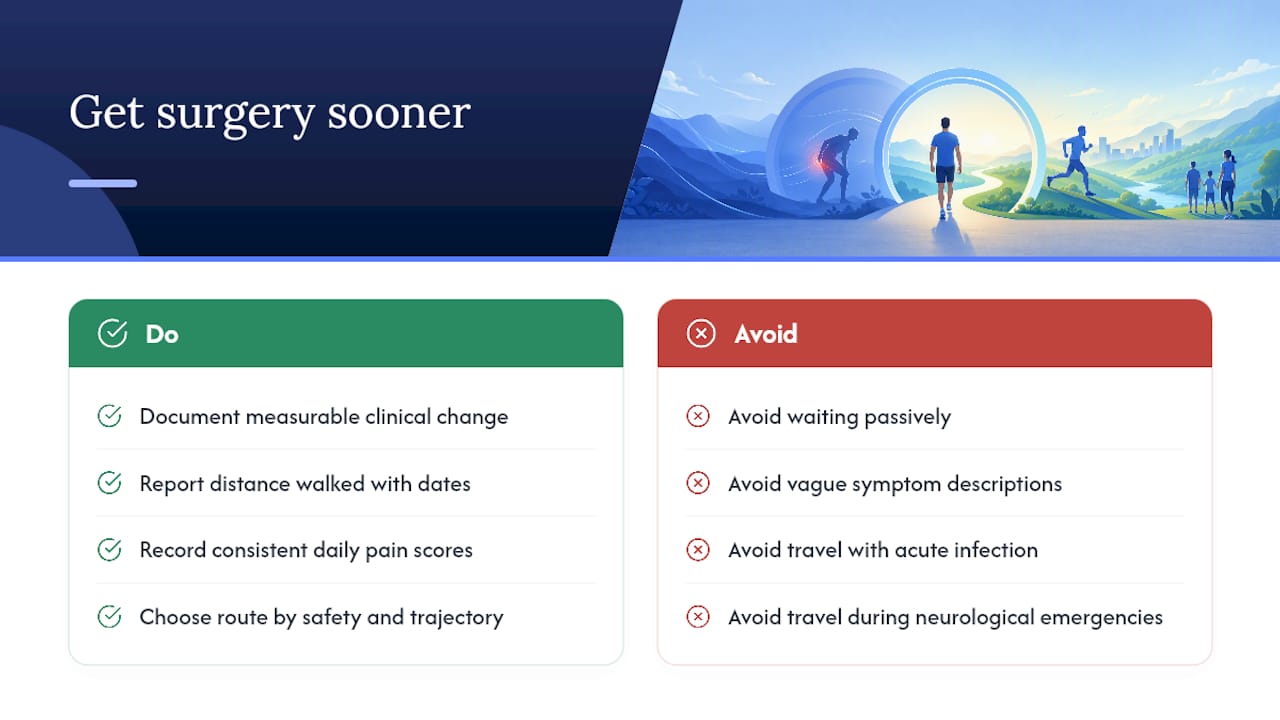
Patients who wait passively rarely get moved up a list. The NHS system responds to documented clinical change, clearly communicated. That is not a criticism of the system; it is how triage works when demand exceeds capacity.
What most guides miss is the asymmetry between how patients describe their symptoms and what clinicians need to act. Saying “my knee is much worse” carries almost no triage weight. Saying “I was walking 500 metres unaided in January; I can now manage 50 metres and require a walking aid, and my pain score has risen from 4 to 8 on a consistent daily basis” is a clinical picture a surgeon can act on.
The same logic applies to choosing between NHS escalation, private care, and medical travel. The decision is not just about cost or speed; it is about which route gives you the safest outcome given your specific condition, your current clinical trajectory, and what your NHS team has already tried. Medical travel to a clinic you have checked can be the right answer for a patient whose condition is stable enough to travel but whose NHS wait is causing ongoing functional loss. It is not the right answer for someone in the middle of an acute infection or a rapidly evolving neurological emergency.
The patients who get surgery sooner, by whatever route, are the ones who document clearly, communicate specifically, and know which lever to pull at each stage.
How to check a clinic abroad before you book
NHS waiting times for many procedures now run well beyond the 18-week standard. Private care in England shortens the wait but rarely reduces the cost. If you are looking at a clinic abroad instead, check it before you pay anything:
- Find the clinic on its country’s official register, under the legal name on the quote.
- Get the surgeon’s name in writing and look them up on their professional register.
- Read the reviews, including the low-rated ones, and check which Google listing is the actual hospital.
- Get the quote itemised in writing, showing what is included and what is not.
- Ask what happens if something goes wrong once you are home.
Most clinics will want your most recent NHS referral letter and any imaging reports before they give a timeline and price. Before changing pathway, discuss the plan with your GP or surgical team so your NHS records remain coordinated.
Thera Travel never recommends a clinic. You can see a free summary of what the records say about a clinic. For spinal conditions, our guides to endoscopic spine surgery abroad and laminectomy abroad cover the procedures and recovery.
This is general information, not medical advice. Consult your GP or surgeon before changing your treatment pathway.
Sources
These are the authoritative pages to consult and to share with your clinical team when making an urgency case or checking your options.
- Guide to NHS waiting times in England
- Planned Elective Surgery
- 111
- Preparing for surgery (RCoA)
- My Planned Care
Download or screenshot the pages most relevant to your situation before your next clinical appointment. Including a printed copy of the NHS waiting-times guide with a referral escalation letter shows the clinical team you understand your rights and have documented your case properly.
This article is general information, not a substitute for advice from a qualified doctor. Consult a qualified healthcare professional about your own circumstances before acting on anything here.
Recommended
- How to Get Surgery Faster Abroad: A Patient’s Guide
- Waiting for the NHS: The Risks of Delaying Decompression Surgery | Thera Travel
- Real Examples of Surgery Savings Abroad: 2026 Guide
- How Patients Access Surgery Abroad: 2026 Guide

Written by Saher Shodhan
Saher Shodhan is the founder of Thera Travel, which publishes what the official records show about clinics abroad, each fact with the date it was checked, and answers patients' enquiries, free. More about Thera → How we write and check our guides →
Related posts

Cross Border Directive: how to get the HSE to refund treatment abroad
Hip and knee replacement abroad from Ireland: costs, waits and HSE refunds