

NHS triage system
What patients need to know
Home › Guides › NHS triage system: what patients need to know

The NHS triage system sorts patients by clinical need, not by who arrived first. Its primary role is safety: identifying who needs urgent care immediately and directing everyone else to the right service at the right time. Triage does not diagnose; it produces a recommended level of care and a timeframe.
You will encounter triage in several NHS settings:
- GP practices using Total Triage or blended digital models, where requests are screened before any appointment is booked
- NHS 111 (phone and online), which uses a structured question flow to assess your symptoms and recommend a next step
- Urgent treatment centres and emergency departments (A&E), where face-to-face triage assigns a clinical priority level
- Digital front-door tools such as urgent care self-service, which redirect patients on arrival before they reach a clinician
The sections below explain how triage decisions are made, what you should expect at each stage, and what to do if you think the outcome is wrong.
Key takeaways
The NHS triage system’s primary role is safety: matching clinical urgency to the right care setting, not managing queues.
| Point | Details |
|---|---|
| Triage is about urgency, not order | Patients are seen by clinical need, not arrival time, across all NHS settings. |
| Digital tools guide but do not diagnose | NHS Pathways generates a care disposition; a clinician review refines it in two-step models. |
| Over-triage is deliberate | Risk-averse design means the system errs towards caution, occasionally directing patients to higher care than needed. |
| Triage does not affect elective waits | A triage decision cannot shorten a waiting list for planned surgery; those waits are governed by NHS capacity. |
| You can escalate | Ask for a clinician review, request a callback, or attend A&E if your condition worsens after any triage outcome. |
Already have a clinic in mind? See what the official records say about it →
Ask us about treatment abroad, free
Tell us what you're looking into. We send your enquiry to relevant, pre-vetted clinics, and up to 3 that can help contact you directly.
Thera is free for patients. No clinic can pay to change the prices we publish.
Table of Contents
- Where does NHS triage actually happen?
- How are triage decisions actually made?
- What happens to you during triage: a step-by-step guide
- Why the NHS uses triage: benefits and the problems patients notice
- NHS Pathways, urgent care self-service and the evidence on safety
- How triage affects your waiting time and access to care
- What to do if you disagree with a triage outcome
- If triage leads to a long wait, there are alternatives worth knowing
- Triage is a safety tool, not a barrier
- Sources
Where does NHS triage actually happen?
The NHS triage process is not one system. It is a family of related processes, each adapted to a different care setting.
GP total triage
Many GP surgeries now use a digitally enabled triage model, often called Total Triage, where every patient request is screened remotely before an appointment is booked. You submit a request online or speak to a receptionist, and a clinician reviews it to decide whether you need a face-to-face appointment, a telephone consultation, or written advice. Blended models combine online consultation tools, two-way messaging, and traditional phone access so that patients who cannot use digital channels are not excluded.

Total Triage is not contractually mandated across all practices, so your experience may vary depending on where you are registered.
NHS 111: phone and online
NHS 111 operates a two-step model across most of England. When you call, a non-clinical Health Advisor works through a structured question flow powered by NHS Pathways, a clinical decision support system. Roughly half of calls proceed to a second step, where a clinician reviews the case, may call you back, and can override or refine the initial recommendation. The online version of NHS 111 uses the same NHS Pathways algorithm.
Northern Ireland uses a different model: a one-step system where a clinician leads the triage call from the outset, which research suggests patients find more reassuring.
Urgent and emergency department triage
At A&E and urgent treatment centres, triage is a face-to-face clinical assessment. A trained clinician assigns an acuity score, typically on a 1–5 scale, using a validated system. The Manchester Triage System is one of the most widely used in England, grouping patients from immediate (level 1) through to non-urgent (level 5). The most acutely unwell patients are seen first, regardless of when they arrived.
NHS England guidance makes clear that validated triage systems should be used and that triage must be performed by a trained clinician, not administrative staff.
Digital front doors: urgent care self-service
Some urgent care settings now use a digital check-in tool called urgent care self-service (also known as Streaming and Redirection). Patients check in on a screen on arrival, answer a short set of questions, and are either directed to the appropriate service within the department or redirected to a pharmacy or urgent treatment centre. NHS Digital reports that this service triages around 50,000 patients per month and actively supports redirection to services such as Pharmacy First.
Key features of urgent care self-service:
- Automatic capture of patient demographics
- Digital prioritisation before a clinician is involved
- Redirection to Pharmacy First or urgent treatment centres
- Support for Booking and Referral Standard (BaRS) referrals
How are triage decisions actually made?
The role of clinical decision support
Triage decisions in telephone and online settings are guided by NHS Pathways, a clinical decision support system maintained by clinically experienced staff. NHS Pathways does not diagnose. It presents a structured sequence of questions and, based on your answers, generates a disposition: a recommended care setting and timeframe. The disposition might be “attend A&E within one hour” or “call back if symptoms worsen in 24 hours.”
The algorithm is deliberately risk-averse. It is designed to err on the side of caution, which means it will sometimes recommend a higher level of care than turns out to be necessary. That is a feature, not a flaw.
The two-step model and clinician oversight
In the NHS 111 telephone model, the first step is handled by a non-clinical Health Advisor following the NHS Pathways question flow. If the case warrants it, a clinician takes over for secondary triage. An observational study published in BMC Medical Informatics and Decision Making found that primary non-clinician triage tends to have higher sensitivity (catching more urgent cases) but lower specificity (also flagging more non-urgent ones as urgent). Clinician-led secondary triage shows greater specificity and better predictive value for actual ED attendance or admission.
Escalation happens automatically when:
- Your answers trigger a high-acuity disposition in NHS Pathways
- A Health Advisor identifies something outside the algorithm’s scope
- Your condition worsens during the call and you report new symptoms
- A clinician reviewing the case decides the initial disposition was insufficient
Pro Tip: If your symptoms change significantly during a triage call, say so immediately rather than waiting to be asked. The algorithm updates based on your answers, and a new symptom can change the recommended disposition entirely.
What happens to you during triage: a step-by-step guide
Telephone and online triage (NHS 111)
- You call 111 or complete the online symptom checker.
- A Health Advisor or the online tool works through NHS Pathways questions: your age, main symptom, duration, severity, and relevant medical history.
- A disposition is generated: this specifies the recommended care setting and how quickly you should be seen.
- If the disposition is high-acuity, a clinician calls you back, usually within the timeframe the disposition specifies.
- Possible outcomes: attend A&E immediately; attend an urgent treatment centre within a set timeframe; book a GP appointment; speak to a pharmacist; manage at home with self-care advice.
GP total triage
- You submit a request online or speak to a receptionist, who records your symptoms.
- A GP or clinical team member reviews the request, usually the same day.
- You receive a callback, a booked appointment (face-to-face or telephone), or written advice.
- In blended models, two-way messaging may be used to gather more information before a decision is made.
Emergency department triage
- You arrive at A&E and are registered.
- A trained clinician performs a brief face-to-face triage assessment, assigning an acuity level (1–5).
- You are directed to the appropriate area of the department or streamed to a different service.
Typical triage dispositions and what they mean in practice:
- Immediate (level 1): Life-threatening. Seen without delay.
- Very urgent (level 2): Seen within 10 minutes.
- Urgent (level 3): Seen within 60 minutes.
- Standard (level 4): Seen within 120 minutes.
- Non-urgent (level 5): Redirected to a GP, pharmacy, or urgent treatment centre; may be given a booked return appointment.
Streaming to a pharmacy or urgent treatment centre does not mean your condition is being dismissed. It means a clinician has judged that a different service can treat you more quickly and appropriately than the emergency department.
Why the NHS uses triage: benefits and the problems patients notice
The benefits
The importance of the triage system comes down to three things: safety, flow, and matching patients to the right clinician.
- Safety: Triage catches time-critical conditions, such as stroke, sepsis, and cardiac events, early enough to make a clinical difference. The risk-averse design of tools like NHS Pathways means the system is more likely to over-refer than to miss something serious.
- Flow: By redirecting non-urgent patients to pharmacies, urgent treatment centres, and GP practices, triage reduces pressure on emergency departments and shortens waits for those who genuinely need them.
- Right clinician, right setting: A patient with a minor wound does not need a consultant. Triage matches clinical need to clinical resource.
The problems patients notice
- Over-triage: Because the system is risk-averse, patients are sometimes directed to a higher level of care than their condition requires. This can feel wasteful, but it is the deliberate trade-off for safety.
- Repetitive questioning: In the two-step NHS 111 model, patients may answer similar questions twice: once with a Health Advisor and again with a clinician. Qualitative research published in BJGP Open found that patients experience this as complex and duplicative, and that empathetic clinician communication makes a significant difference to how the process feels.
- Digital exclusion: Total Triage and online tools assume patients can access and use digital services. NHS England guidance explicitly requires practices to preserve traditional access routes for vulnerable patients, including those who are elderly, have disabilities, or lack internet access.
- Communication gaps: Scripted non-clinician interactions can feel impersonal and leave patients uncertain about why a particular outcome was reached.
Pro Tip: Before you call 111 or submit a GP triage request, write down your main symptom, when it started, how severe it is on a scale of 1–10, and any relevant medical history or medications. Triage systems work faster and more accurately when you can answer questions quickly and precisely.
NHS Pathways, urgent care self-service and the evidence on safety
NHS Pathways
NHS Pathways underpins NHS 111 (phone and online), NHS 999, and integrated urgent care services across England. It is not a diagnostic tool. It generates dispositions that specify urgency and recommended care setting, and it is maintained by clinically experienced staff who author and test scenarios continuously. Clinical governance sits with NHS Digital, and the system is updated when new clinical evidence or service changes require it.
Urgent care self-service
The urgent care self-service product is a digital front door deployed at urgent care settings. Patients check in digitally on arrival, answer a short triage questionnaire, and are either prioritised within the department or redirected to Pharmacy First or an urgent treatment centre. The system captures demographics automatically, supports BaRS referrals, and handles around 50,000 triage interactions per month. When integrated with clinician pathways and scheduling standards, it improves both safety and flow in waiting areas.
What the evidence says about accuracy
The observational study in BMC Medical Informatics and Decision Making found a meaningful trade-off in two-step systems: primary non-clinician triage catches more urgent cases (higher sensitivity) but also flags more non-urgent cases as urgent (lower specificity). Clinician-led secondary triage corrects much of this, showing stronger predictive value for which patients will actually attend an ED or be admitted. The implication is that the two-step model works as designed: the first step casts a wide safety net, and the second step refines it.
How triage affects your waiting time and access to care
Triage and NHS waiting lists are different things, and conflating them causes real confusion.
Triage determines clinical urgency and directs you to the right care setting within urgent and emergency services. It can speed up access significantly for acute conditions.
Waiting lists govern elective care: planned procedures, outpatient appointments, and non-urgent referrals. Triage does not shorten an NHS spinal surgery waiting time or move you up a list for a knee replacement.
Where triage can shorten your wait:
- Streaming to a same-day urgent treatment centre instead of waiting in A&E
- Redirecting to Pharmacy First for conditions a pharmacist can treat immediately
- A GP triage callback that resolves your concern without a face-to-face appointment
Where triage cannot help:
- Elective surgery waiting lists (hip replacement, knee replacement, spinal procedures)
- Routine outpatient referrals
- Non-urgent diagnostic tests
If your triage outcome is a routine GP referral for an elective procedure, the wait for that procedure is governed by NHS capacity, not by the triage decision. The NHS Waiting List Calculator can help you estimate how long that wait might be for your specific procedure.
What to do if you disagree with a triage outcome
Triage decisions are clinical recommendations, not final verdicts. You have the right to question them.
- Ask for a clinician review. If a non-clinical Health Advisor gave you a disposition you are not confident in, ask to speak to a clinician. In the NHS 111 two-step model, this is part of the standard process.
- Request a callback. If you are told to manage at home and your condition worsens, call 111 again or ask your GP practice for an urgent callback. You are not bound by the original disposition if your symptoms change.
- Attend A&E if you believe your condition is life-threatening. No triage outcome should prevent you from attending an emergency department. If you develop signs of stroke (FAST: Face drooping, Arm weakness, Speech difficulty, Time to call 999), chest pain, difficulty breathing, or loss of consciousness, call 999 immediately.
- Note the details. Write down the time of the call or assessment, the name of the person you spoke to, and the advice given. This is useful if you need to make a formal complaint.
- Use the formal complaints process. If you believe a triage decision caused harm or was handled poorly, you can raise a concern with the GP practice, NHS 111 provider, or NHS trust involved. Every NHS provider has a Patient Advice and Liaison Service (PALS) that can guide you through the process.
Safety-net questions to ask during any triage assessment:
- “What symptoms should I watch for that would mean I need to seek urgent care?”
- “What is the timeframe I should be seen within?”
- “What should I do if I cannot get through to the service you are directing me to?”
- “Can I speak to a clinician if I am not confident in this advice?”
If your triage outcome leads to a long wait for an elective procedure and you are considering your options, the guide on overseas treatment options explains pathways that some patients use to access planned procedures more quickly.
If triage leads to a long wait, there are alternatives worth knowing
For patients whose triage outcome is a referral for elective surgery, the NHS waiting list can stretch to 18 months or more for procedures such as spinal surgery, knee replacement, or hip replacement. Some patients in that position look at private treatment abroad. If you do, check the clinic first: its entry on the official register, the surgeon's registration, and its reviews, including the low-rated ones.
Thera Travel never recommends a clinic. You can look up a clinic and see what the official records say about it, free. For spinal patients, our guide to endoscopic spine surgery abroad explains one of the options.
Triage is a safety tool, not a barrier
Most patients who feel frustrated by triage are reacting to the same thing: a system that seems to add steps between them and a clinician. That frustration is understandable. But the design logic is sound. A system that catches every serious case, even at the cost of occasionally over-referring, is safer than one that tries to be perfectly efficient and misses something critical.
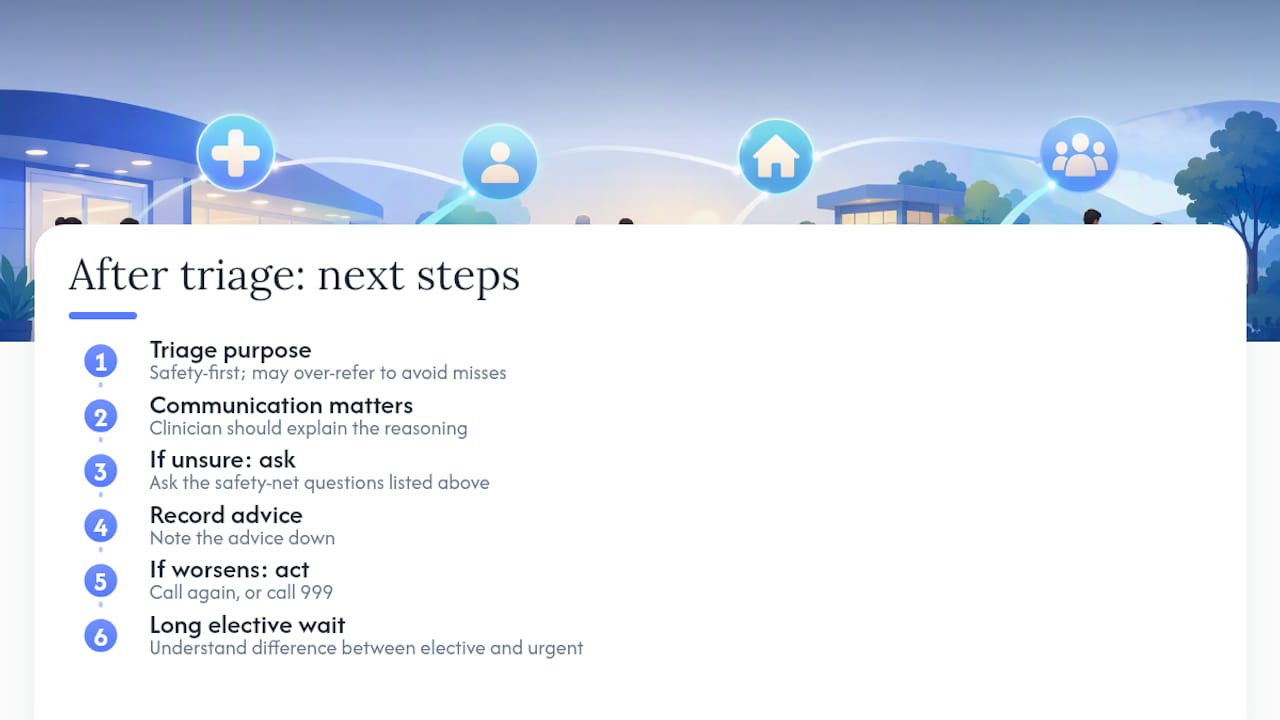
What I think patients underestimate is how much the communication around triage matters. The algorithm can be well-designed and still leave someone feeling dismissed if the person delivering the outcome does not explain the reasoning. The research on two-step triage bears this out: the clinical accuracy is broadly good, but the experience varies enormously depending on whether a clinician is involved and how they communicate.
If you leave a triage interaction unsure of what to watch for or what to do next, that is a gap worth closing. Ask the safety-net questions listed above. Note the advice down. And if your condition worsens, do not wait: call again, or call 999.
For patients whose triage outcome leads to a long elective wait rather than urgent care, that is a separate problem with separate solutions. Understanding the difference between the two is the first practical step.
This article is general information, not a substitute for advice from a qualified doctor. Consult a qualified healthcare professional about your own circumstances before acting on anything here.
Sources
The following NHS and peer-reviewed sources underpin this guide and are worth bookmarking for further reading:
- Digitally enabled triage
- NHS Pathways
- Exploring two-step and one-step urgent care telephone triage: a UK-based semi-structured interview study | BJGP Open
Recommended
- NHS Spinal Surgery Waiting Time 2026: 18 Months to 3 Years
- NHS Waiting List Calculator
- Waiting for the NHS: The Risks of Delaying Decompression Surgery | Thera Travel
- Why Doctors Refer Patients Abroad: A 2026 Guide

Written by Saher Shodhan
Saher Shodhan is the founder of Thera Travel, which publishes what the official records show about clinics abroad, each fact with the date it was checked, and answers patients' enquiries, free. More about Thera → How we write and check our guides →
Related posts
Cross Border Directive: how to get the HSE to refund treatment abroad
Hip and knee replacement abroad from Ireland: costs, waits and HSE refunds