

How to review international clinic patient outcomes
Home › Guides › How to review international clinic patient outcomes

A clinic’s patient outcomes are trustworthy only when you can verify the surgeon’s registration, see dated audit data, confirm documented complication and revision rates, and get a written aftercare plan before you pay a penny. Anything short of that is marketing.
Here is the checklist to use before committing to any deposit:
- Surgeon’s full name and registration number (verifiable in an official national registry)
- Dated audit report or anonymised PROMs dataset (not a testimonial page)
- Complication, revision, and readmission rates for your specific procedure
- Written aftercare plan naming who provides face-to-face follow-up and for how long
- Repatriation and complication cost policy in writing
- Confirmation your UK GP has been consulted and will receive translated records on return
If a clinic cannot supply all six within a reasonable timeframe, do not proceed.
Pro Tip: Ask the surgeon to share an EPIC or MyIntealth primary-source verified report. This is stronger than any CV or certificate scan because the credentials are verified at source, not self-reported.
Table of Contents
- Which patient outcome metrics should you actually request?
- How do you verify the clinic and surgeon before booking?
- How can you tell genuine patient reviews from clinic marketing?
- What aftercare and complication arrangements must be in place before you travel?
- Printable checklist: questions to ask the clinic before you book
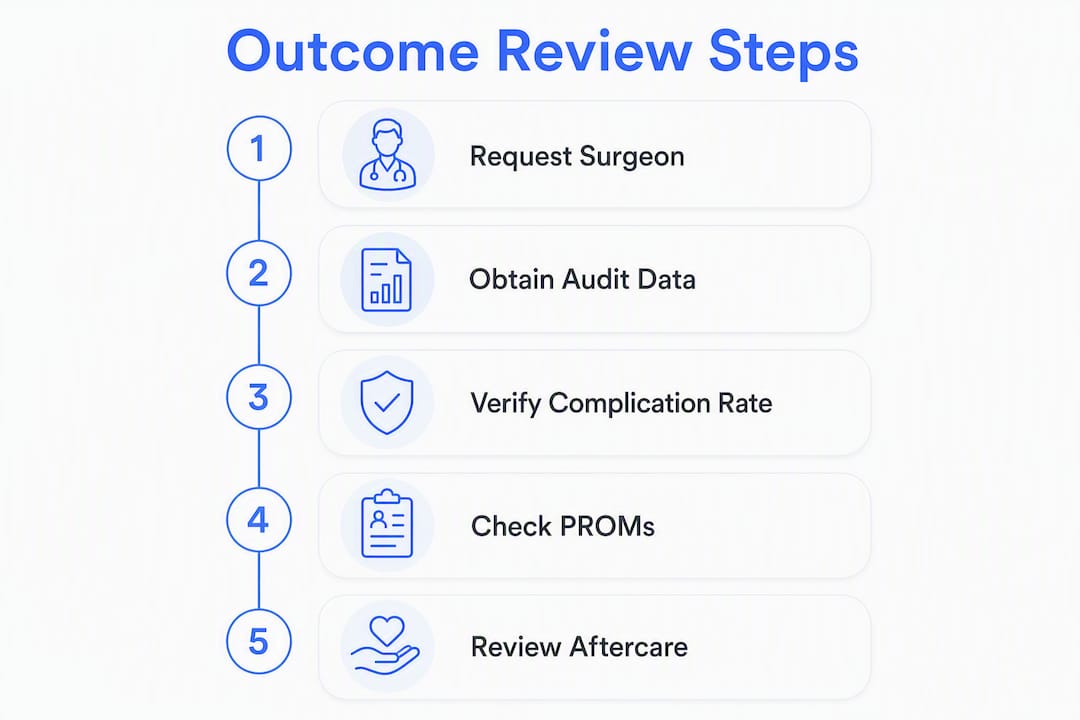
- How to request verified outcome data: a step-by-step approach
- Key takeaways
- A note on what actually matters when verifying outcomes abroad
- How to check a clinic before you book
- Authoritative sources and registries to verify credentials yourself
Ask us about treatment abroad, free
Tell us what you're looking into. We send your enquiry to relevant, pre-vetted clinics, and up to 3 that can help contact you directly.
Thera is free for patients. No clinic can pay to change the prices we publish.
Which patient outcome metrics should you actually request?
Not all outcome data carries equal weight. Social media testimonials tell you how a patient felt; audited metrics tell you what actually happened clinically.
| Metric | What it measures | Acceptable benchmark (elective procedures) |
|---|---|---|
| Complication rate | Adverse events during or after surgery | Varies by procedure; ask for the clinic’s own rate vs published literature |
| Infection rate | Post-surgical site infections | Should be below published national averages for the procedure type |
| Revision/readmission rate | Patients requiring repeat surgery or hospital re-admission | Lower is better; any refusal to share this is a red flag |
| PROMs (Patient-Reported Outcome Measures) | Patient-assessed function, pain, and quality of life post-procedure | Standardised tools allow comparison |
| Mortality rate | Relevant for higher-risk procedures | Should match or beat national averages; demand the denominator |
| Average recovery timeline | Typical length of stay and return-to-activity period | Procedure-specific; use to plan travel and minimum stay before flying |
Already have a clinic in mind? See what the official records say about it →
PROMs and dated audit reports are the gold standard because they capture what patients experience after discharge, not just what the surgeon records in theatre. A clinic that publishes only five-star Google reviews and before/after photos is showing you its marketing, not its outcomes.
The NHS treatment abroad checklist recommends arranging translated medical records for your UK clinician on return. That is only possible if the clinic produces records in the first place. A clinic that cannot commit to full documentation is one to avoid.
A rapid review of outward medical tourism found that 655 patients were treated by NHS hospitals for complications following elective surgery abroad, with costs to the NHS ranging from £1,058 to £19,549 per patient. That figure puts the real cost of a poor outcome into perspective when you are weighing a headline price saving.
How do you verify the clinic and surgeon before booking?

Verification is a process, not a single document check. Work through it in order.
Documents and registries to demand:
- Surgeon’s full name, primary qualification, and licence number in their country of practice
- Confirmation the surgeon is listed in that country’s national medical register (most are searchable online)
- Evidence of specific experience with your procedure (number of cases performed, not just years qualified)
- The clinic’s physical operating licence for treating international patients
- JCI accreditation status confirmed via the JCI searchable directory — a clinic claiming JCI status should appear there; if it does not, that is an automatic red flag.
- A dated, signed treatment plan before any payment
Experts advise requesting an EPIC or MyIntealth verified report directly from the surgeon. This is a primary-source credential check, not a self-certified document.
A legitimate clinic will not pressure you to pay a deposit before naming the performing surgeon. Pressure to pay before staff are named is one of the clearest red flags in medical tourism.
Red flags that should stop you immediately
- Unnamed or unverifiable surgeon
- Virtual-only address with no physical clinic licence
- Refusal to provide audit reports or complication data
- JCI claim that does not appear in the public directory
- Requests for payment before a signed treatment plan is issued
Pro Tip: Search the surgeon’s name alongside the clinic name in Google Scholar or PubMed. Published surgeons leave a traceable academic footprint. A complete absence of any professional record outside the clinic’s own website warrants further scrutiny.
How can you tell genuine patient reviews from clinic marketing?
Clinical marketing frequently emphasises dramatic visual results rather than audited outcomes. Before/after photos, influencer endorsements, and package promotions can look compelling, but none of them constitute clinical evidence.
A credible patient review includes: the procedure performed, the surgeon or department named, a realistic recovery timeline, an honest account of any complications or discomfort, and a timestamp. Reviews that read identically across multiple platforms, appear in sudden bursts, or receive unusually fast and templated clinic responses are consistent with manipulation.
High social media presence and influencer endorsements are frequently paid promotions and carry no clinical weight whatsoever.
Checklist for a credible review:
- Posted on a third-party platform (Google, Trustpilot, or a verified health review site) with a timestamp
- Names the specific procedure and, where possible, the treating clinician
- Describes recovery honestly, including any setbacks
- Is not duplicated word-for-word across multiple platforms
- Does not appear alongside a cluster of similar reviews posted within days of each other
To corroborate a testimonial, ask the clinic whether reviews are independently verified and whether they can provide contactable case references where ethically permissible. You can also ask a UK clinician to review a published case summary and give an independent opinion on whether the described outcome is plausible for that procedure.
Pro Tip: Copy a suspicious review’s exact wording into a search engine. Fabricated or templated reviews often appear verbatim on multiple clinic websites or review platforms.
What aftercare and complication arrangements must be in place before you travel?
Travel Aware warns that aftercare is the most neglected part of medical tourism, and that remote aftercare via messaging apps is clinically insufficient for serious post-operative complications. Flying home too soon after surgery also raises the risk of deep vein thrombosis.
Before you travel, the clinic must confirm in writing:
- Who provides face-to-face follow-up, at what intervals, and for how long after discharge
- The escalation route if a complication arises (local re-admission, transfer to a higher-level facility, or repatriation)
- Who bears the financial responsibility for revision surgery or emergency care
- The minimum recommended stay in-country before flying, specific to your procedure
“Travelling abroad increases the risk of complications, and aftercare is often insufficient when compared with UK standards. Patients should plan to stay in the country for an appropriate recovery period and arrange comprehensive cover before travelling.” — Travel Aware / FCDO
Legal recourse for complications after surgery abroad is difficult and expensive. UK patients should assume limited ability to enforce negligence claims in foreign jurisdictions. That reality makes written agreements and specialist medical travel insurance non-negotiable before departure.
Many clinics issue package pricing that excludes tests, medication, follow-up visits, or revision surgery. Get an itemised quote and confirm exclusions in writing. The hidden costs of surgery abroad can erode savings quickly when complications arise.
Printable checklist: questions to ask the clinic before you book
Use these questions by phone or email. Save every written response.
- What is the performing surgeon’s full name, registration number, and primary qualification?
- Can you provide a dated audit report or anonymised PROMs summary for this procedure?
- What are your complication, revision, and readmission rates for this procedure over the past two years?
- Who provides face-to-face aftercare after discharge, and for how long?
- What is your written policy if I develop a complication after returning to the UK?
- Who is financially responsible for revision surgery or emergency care?
- Are your patient reviews independently verified? Can you provide contactable case references?
- Can you provide a fully itemised quote that lists all exclusions?
- Will you supply translated medical records for my UK GP on completion of treatment?
- Is the clinic JCI-accredited, and can you confirm this in the JCI public directory?
Consulting your GP or a UK specialist before booking is not optional. It is the step that confirms clinical necessity, surfaces contraindications, and ensures your UK clinician can provide continuity of care on your return.
How to request verified outcome data: a step-by-step approach
Step 1 — Request surgeon details. Email the clinic asking for the surgeon’s full name, registration number, primary qualification, and the number of times they have performed your specific procedure. State that you will verify the registration independently.
Step 2 — Ask for dated audit data. Request a dated audit summary or anonymised PROMs dataset for your procedure from the past 24 months. A trustworthy clinic will have this; an evasive reply is informative in itself.
Step 3 — Request EPIC or MyIntealth verification. The EPIC and MyIntealth process allows surgeons to share a primary-source verified education and identity report. Ask the surgeon directly to initiate a share.
Step 4 — Confirm aftercare and complication policy in writing. Do not accept verbal assurances. Ask for the written policy document before any payment.
Sample email opening: “I am considering treatment at your clinic and would like to request the following before proceeding: the performing surgeon’s full name and registration number; a dated audit summary or anonymised PROMs for [procedure]; confirmation of your complication and revision rates; and your written aftercare and complication policy. I will be verifying credentials independently and sharing all documentation with my UK GP.”
A comprehensive reply arrives within a few working days and addresses every point. An evasive reply, a redirect to a brochure, or a request for payment before answering are all reasons to look elsewhere.
Pro Tip: Save every email with its date and time stamp. Print or export to PDF. Your UK GP and any specialist medical travel insurer will want to see this paper trail.
Key takeaways
Verified patient outcomes require named surgeon credentials, dated audit data, documented complication rates, and a written aftercare plan before any deposit changes hands.
| Point | Details |
|---|---|
| Verify surgeon and facility | Confirm the surgeon’s registration in an official national registry and check JCI accreditation in the public directory. |
| Demand dated audit data and PROMs | Testimonials and before/after photos are not clinical evidence; request anonymised audit reports from the past 24 months. |
| Secure written aftercare | Get the complication policy, escalation route, and financial responsibility for revision care confirmed in writing before travel. |
| Consult your UK GP first | NHS guidance recommends GP sign-off before booking to confirm clinical necessity and arrange continuity of care. |
| Start with the official records | Check the clinic’s register entry and the surgeon’s registration first. They take minutes and rule out the clinics that cannot pass the basics. |
This article provides general information, not medical or legal advice. Confirm current clinical and regulatory requirements with your GP, a qualified specialist, or the relevant primary authority before booking any treatment abroad.
A note on what actually matters when verifying outcomes abroad
The conventional wisdom in medical tourism is that accreditation is the answer. Get a JCI-accredited hospital, the thinking goes, and the risk is managed. That is too simple.
JCI accreditation tells you a hospital met a set of process and governance standards at the time of its last inspection. It does not tell you the revision rate for the specific surgeon performing your procedure, whether the clinic’s aftercare model is adequate for your recovery, or whether the outcome data it publishes has been independently audited. Accreditation is a floor, not a ceiling.
The more useful question is whether the clinic can show you its work: dated, procedure-specific audit data, named surgeon credentials that check out in a public registry, and a written plan for what happens if something goes wrong after you land back at Heathrow. Clinics that genuinely perform well are not reluctant to share that evidence. The ones that deflect, redirect, or pressure you to pay first are telling you something important.
Patient regret after overseas elective care is strongly associated with complications managed after returning home. The pre-booking verification process is not bureaucratic caution. It is the single most effective thing you can do to protect yourself.
How to check a clinic before you book
Spending weeks emailing clinics and cross-referencing registers is the kind of friction that leads patients to skip checks and rely on reviews alone. If time is short, these five are the ones to keep:
- Find the clinic on its country’s official register, under the legal name on the quote.
- Get the surgeon’s name in writing and look them up on their professional register.
- Read the reviews, including the low-rated ones, and check which Google listing is the actual hospital.
- Get the quote itemised in writing, showing what is included and what is not.
- Ask what happens if something goes wrong once you are home.
Thera Travel does this groundwork from the records and never recommends a clinic. You can look up a clinic for a free summary. If you are weighing up endoscopic spine surgery abroad, that guide covers the procedure, or you can browse clinics by country.
Authoritative sources and registries to verify credentials yourself
- NaTHNaC — Travelling for Treatment (TravelHealthPro): UK travel health guidance on medical tourism risks; covers pre-travel advice and procedure-specific considerations. Does not verify individual surgeon credentials.
- Travel Aware — Surgery Abroad, Cut Out the Risk (FCDO): UK government guidance on aftercare risks, recovery timelines, and GP sign-off requirements before travelling for surgery.
- NHS Treatment Abroad Checklist: Step-by-step checklist for UK patients; covers funding, records, and continuity of care. Does not assess individual clinic quality.
- Joint Commission International — Accredited Organisations Directory: Searchable public directory to confirm a clinic’s JCI accreditation status. Shows accreditation; does not show individual surgeon revision rates.
- PHIN — Risks of Medical Tourism: Independent UK healthcare information on practitioner registration, legal recourse, and insurance gaps for patients considering treatment abroad.
- Complications and Costs to the NHS from Outward Medical Tourism (medRxiv rapid review): Academic review of NHS-treated complications following elective surgery abroad; useful for contextualising complication risk by procedure type.
Save copies of any audit reports or surgeon verification documents and bring them to your UK GP before you book.
Recommended
- Overseas Hospital Room Standards: What Patients Need to Know
- Hidden Costs of Medical Tourism: Your 2026 Checklist
- Private surgery abroad: benefits and NHS alternative guide
- Managing family logistics during medical travel: a UK guide

Written by Saher Shodhan
Saher Shodhan is the founder of Thera Travel, which publishes what the official records show about clinics abroad, each fact with the date it was checked, and answers patients' enquiries, free. More about Thera → How we write and check our guides →
Related posts

Cross Border Directive: how to get the HSE to refund treatment abroad
Hip and knee replacement abroad from Ireland: costs, waits and HSE refunds