

Why coordinated family medical packages work for UK families
Home › Guides › Why coordinated family medical packages work for UK families

For many UK families weighing elective treatment abroad, a coordinated medical package makes the logistics simpler. One contact manages the procedure, travel, accommodation and aftercare. Whether it is worth it depends on what the contract covers and whether the clinic checks out. The immediate next step: check your Global Health Insurance Card (GHIC) status, secure comprehensive medical travel insurance that includes post-operative complications and, in extreme cases, emergency repatriation, as standard UK travel insurance may not cover planned medical procedures. Then look the clinic up on its country's official medical register before you ask for a quote.
Key takeaways
Coordinated family medical packages are worth pursuing when the clinic is on its official register, the provider gives you a written aftercare plan, and repatriation cover is in the contract.
| Point | Details |
|---|---|
| Prices vary widely | The gap against UK private fees depends on the procedure, the country and what the package includes; always compare itemised quotes. |
| Insurance is non-negotiable | Standard travel insurance excludes planned procedures and their complications; secure comprehensive medical travel insurance that includes post-operative complications and emergency repatriation before requesting any quote. |
| Written contracts protect you | Confirm who pays for complications, dressings and emergency transfers before signing anything. |
| Clinic verification matters most | Check surgeon registration and hospital accreditation independently, not just from clinic marketing materials. |
| Read the reviews properly | Read the low-rated reviews too, and check that the Google listing is the actual hospital, not an agent. |
Already have a clinic in mind? See what the official records say about it →
Ask us about treatment abroad, free
Tell us what you're looking into. We send your enquiry to relevant, pre-vetted clinics, and up to 3 that can help contact you directly.
Thera is free for patients. No clinic can pay to change the prices we publish.
Table of Contents
- What are the real benefits of coordinated family medical packages?
- What does a typical coordinated package include?
- What safety risks should families watch for?
- How do you check a provider and clinic?
- What do coordinated packages cost and how long does the process take?
- Aftercare abroad and returning to the UK
- How do you read patient reviews and verify trust signals?
- What can your family do today?
- An editorial note on why coordinated packages matter
- How to check a clinic before you book
- Sources
What are the real benefits of coordinated family medical packages?
The benefits of coordinated travel and surgery packages go well beyond a cheaper headline price. Here is what families actually gain.
One price, compared like for like. UK private fees for orthopaedic surgery, dental implants or bariatric procedures can run to tens of thousands of pounds. A coordinated package bundles the procedure, surgeon fees, anaesthesia, hospital stay, transfers and accommodation into one price, so you are comparing like for like rather than discovering extras after you have committed.

Faster access. Historical surveys show many UK residents seek elective treatment abroad each year, commonly for fertility, cosmetic, bariatric and dental procedures, largely because NHS waiting lists stretch well beyond what many families can absorb. A coordinated package typically compresses the timeline from enquiry to surgery into weeks rather than months.
One point of contact. Coordinating flights, transfers, accommodation, translators and clinical appointments across a foreign country is genuinely difficult. A well-structured package removes that burden entirely. One coordinator handles logistics for both the patient and accompanying family members, which matters most when a carer or child is travelling alongside.
Family-friendly logistics. Recovery-appropriate accommodation, options for accompanying carers, and child-friendly arrangements are built into quality packages rather than bolted on as extras. Policy research confirms that platforms which check clinics and publish transparent reviews reduce the cognitive burden of sorting reliable options from unreliable ones.
Stat to note: Medical tourism is driven by affordability, shorter waiting times and wider treatment availability, but variation in regulatory standards and aftercare remains the primary risk families need to mitigate.
What does a typical coordinated package include?
Package types vary, but a well-structured all-inclusive offer should cover the following components. Missing items in a quote are a red flag, not a negotiating point.
- Core medical elements: pre-operative consultation, surgery, surgeon and anaesthetist fees, hospital stay and all in-clinic nursing care.
- Travel and logistics: return flights or flight-booking assistance, airport transfers on arrival and departure, and local transport between accommodation and clinic.
- Accommodation: recovery-appropriate accommodation for the patient, with options for accompanying family members to stay nearby or on-site.
- Aftercare services: scheduled follow-up appointments, dressings, prescriptions, rehabilitation sessions where relevant, and telehealth check-ins after you return home.
- Support extras: professional translators or interpreters, local emergency contacts available around the clock, discharge documentation formatted for NHS clinicians, and a written repatriation plan.
Any quote that omits aftercare or repatriation planning should be treated with caution before signing anything.
What safety risks should families watch for?
Medical tourism delivers real benefits but exposes patients to harm when standards vary. A well-structured package can reduce the main risks, but families need to understand what those risks are.
The key risks:
- Variable clinical and regulatory standards across destination countries
- Aftercare gaps once a patient leaves the clinic and returns to non-clinical accommodation
- Contracts that are vague about who pays for complications or extended stays
- Standard travel insurance that excludes planned medical procedures and their complications
- Travel-related complications such as deep vein thrombosis after long-haul flights post-surgery
What reduces those risks
- Checking the clinic against the official medical register before you commit
- Written contracts specifying responsibility for complications, extended stays and repatriation
- Written aftercare clauses naming who arranges follow-ups and who covers the cost
- NaTHNaC guidance is clear: comprehensive medical travel insurance covering post-operative complications and emergency repatriation is non-negotiable, because standard travel insurance typically excludes planned procedures
GHIC limits: Your GHIC gives access to state-provided healthcare in EU countries at the same cost as a local resident. It does not cover private treatment, repatriation, or complications from elective procedures. It is a supplement to proper medical travel insurance, not a substitute.
Pro Tip: When reviewing an aftercare clause, look for explicit answers to three questions: who pays for post-operative dressings and medications, who arranges follow-up appointments, and who is financially responsible for emergency transfers if complications arise. Vague wording like “aftercare provided as appropriate” is not a commitment.
How do you check a provider and clinic?
A step-by-step vetting approach protects families from the most common pitfalls. Work through this checklist before committing to any provider or clinic.
Selection criteria to confirm:
- Clinic accreditation verified against the destination country’s official medical register or an internationally recognised body such as JCI (Joint Commission International).
- Surgeon registration confirmed with the relevant national medical council.
- Transparent, itemised pricing published before you ask for a quote.
- A written aftercare plan included in the package, not offered as an optional add-on.
- Verified patient reviews with dates, procedure types and consistent clinic responses.
- Demonstrable experience coordinating travel logistics for families, not just individual patients.
Questions to ask before signing
- Who holds contractual responsibility if complications arise during or after treatment?
- What exactly is included, and what triggers additional charges?
- What is the repatriation policy and who pays for it?
- Can you speak directly with a previous patient who had the same procedure?
Red flags to reject immediately
- Credentials that cannot be independently verified online
- Pressure to pay the full fee upfront before a written contract is issued
- No published aftercare plan or vague references to “ongoing support”
- Reviews that lack dates, procedure details or any critical commentary
The dental tourism safety checklist offers a useful parallel framework for procedure-specific checks, particularly for dental implant or cosmetic dentistry packages.
Prioritise contractual clarity and clinical verification over the lowest headline price. A saving of a few hundred pounds on a package that omits aftercare can cost far more to resolve once you are home.
What do coordinated packages cost and how long does the process take?
Pricing structures vary, but most reputable packages are offered as a single all-inclusive price covering the components listed above. Some providers offer itemised quotes instead; both formats are acceptable provided every line item is specified in writing.
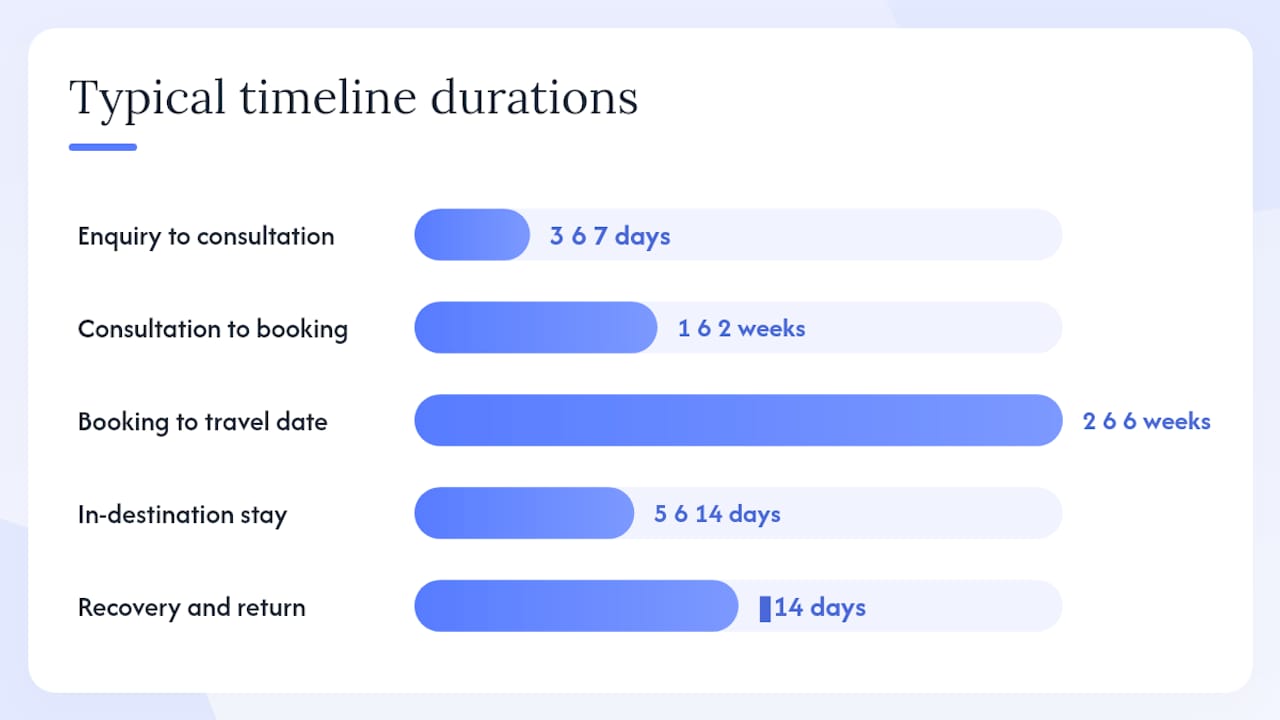
Typical timeline stages
- Initial enquiry to remote consultation: 3–7 days for most elective procedures
- Remote consultation to confirmed booking: 1–2 weeks, including medical records review
- Booking to travel date: 2–6 weeks depending on procedure complexity and clinic availability
- In-destination stay: typically 5–14 days for surgical procedures, shorter for dental or diagnostic work
- Recovery and return: most patients return to the UK within two weeks; full recovery timelines depend on the procedure
Watch for hidden costs. Additional diagnostics requested on arrival, extended accommodation if recovery is slower than expected, and post-return prescriptions not covered by the package are the three most common sources of unexpected expense. Confirm deposit and refund terms in writing before paying anything. Family travel insurance covering the whole group is often more cost-effective than individual policies and should include cancellation, medical emergencies, repatriation and additional accommodation during hospital stays.
Use the NHS waiting list calculator to compare your current NHS timeline against the expected treatment window abroad.
Aftercare abroad and returning to the UK
Before leaving the destination clinic, secure the following in writing. Missing documentation creates real problems when you present to NHS clinicians.
- Written aftercare plan specifying dressings schedule, medication names and doses, activity restrictions and follow-up appointment dates.
- Discharge summary in English, including the procedure performed, surgeon’s name and registration number, and any intraoperative findings.
- Imaging and pathology reports on a disc or via secure digital transfer.
- Medication list with generic drug names, dosages and duration.
- Remote follow-up contact details for the treating surgeon or clinic coordinator.
- Repatriation insurance confirmation from your insurer, including the emergency number to call if complications arise after landing.
Newcastle Hospitals guidance stresses discussing travel plans with your clinical team, securing appropriate insurance and keeping documentation to avoid invalidating cover or incurring unexpected costs. The same principle applies when returning from treatment abroad: notify your GP immediately, bring all documentation to the first appointment, and contact your insurer before seeking NHS emergency care for a complication, since the order of contact can affect reimbursement.
How do you read patient reviews and verify trust signals?
Authentic reviews look different from curated ones. Policy research notes that the main challenge for families is sorting anecdote from evidence online. Checking the official records yourself, rather than relying on a clinic's own marketing, reduces that burden.
What genuine reviews include:
- Specific procedure name and approximate date
- Recovery timeline with realistic detail, including any complications or delays
- Verified reviewer status (linked profile, confirmed booking)
- Consistent, professional responses from the clinic addressing specific points raised
- Before-and-after documentation where clinically appropriate
Verification steps beyond reviews
- Check the surgeon’s registration on the destination country’s official medical council website
- Confirm hospital accreditation independently, not just from the clinic’s own marketing materials
- Look the clinic up in Thera Travel’s directory of clinics, which gives a free summary of its register entry and Google reviews
WellChild’s planning resources show that checklists and peer experience are effective tools for reducing planning anxiety, particularly for families travelling with children or medically vulnerable relatives. The same structured approach applies when evaluating reviews: use a checklist rather than relying on overall star ratings alone.
What can your family do today?
A short, practical checklist to move from consideration to action.
- Check your GHIC status at gov.uk and confirm it covers your destination country.
- Secure comprehensive medical travel insurance before requesting any clinic quotes; confirm it covers post-operative complications, repatriation and extended accommodation. Family decision-making guidance can help you align on priorities before approaching providers.
- Check the clinic on its official register before you ask for a quote, and ask for itemised breakdowns alongside the all-inclusive price.
- Ask for a written aftercare plan as part of any quote, not as a post-booking add-on.
- Book a remote consultation before committing to travel; a reputable clinic will offer this as standard.
- Use the NHS waiting list calculator to compare your current NHS timeline with the expected treatment window abroad.
- Notify your GP and any specialist team before booking, particularly if you or a family member has complex medical needs. Guidance for families navigating overseas surgery covers specialist consultation steps in detail.
An editorial note on why coordinated packages matter
The case for coordinated family medical packages is not primarily about cost, though the savings are real. It is about what happens when things do not go exactly to plan. An uncoordinated booking, where a family has arranged flights, accommodation and a clinic independently, leaves them without a single responsible party when a complication arises or a follow-up appointment needs rescheduling. A coordinated package with a written contract can change that, provided the provider and the clinic both check out.
The checks that matter are the ones policy researchers and health authorities flag most often: the clinic's entry on the official register, the surgeon's registration, genuine reviews, a single itemised price and a written aftercare plan. A lower price is a real draw, but the written contract, the aftercare terms and the repatriation clause are what protect families when the unexpected happens.
The families who benefit most are those who treat the vetting process as seriously as the procedure itself.
How to check a clinic before you book
Whoever sells the package, the clinic is where the treatment happens. Before you pay a deposit:
- Find the clinic's register entry on its country's official register, under the legal name printed on the quote.
- Get the surgeon's name in writing and look them up on their professional register.
- Read the reviews, including the low-rated ones, and check which Google listing is the actual hospital.
- Get the quote itemised in writing, showing what is included and what is not.
- Ask what happens if something goes wrong once you are home, and who pays.
Our 15 questions to ask a clinic set these out in full. Thera Travel does not recommend or book any clinic. You can see a free summary of what the records say about a clinic. For orthopaedic procedures, guides such as endoscopic spine surgery abroad explain the procedure and typical costs.
Sources
- Medical Tourism policy brief — NIHR PRU Behavioural and Social Sciences
- Going on holiday after a transplant — Newcastle Hospitals
- Outward medical tourism — House of Commons Library / POST briefing
- Taking your child with complex medical needs on holiday — WellChild
- Family travel insurance — The Telegraph
Recommended
- Benefits of Coordinated Travel and Surgery Packages
- Spinal Fusion Cost: UK Private vs Poland
- Types of Medical Travel Packages Available in 2026
- Why Families Research Healthcare Abroad in 2026

Written by Saher Shodhan
Saher Shodhan is the founder of Thera Travel, which publishes what the official records show about clinics abroad, each fact with the date it was checked, and answers patients' enquiries, free. More about Thera → How we write and check our guides →
Related posts

Cross Border Directive: how to get the HSE to refund treatment abroad
Hip and knee replacement abroad from Ireland: costs, waits and HSE refunds